
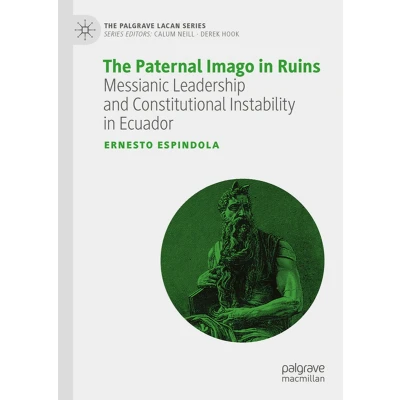
The Paternal Imago in Ruins: Messianic Leadership and Constitutional Instability Ecuador
Uitgelicht

|
139,00
135,00 |
Naar shop
|

|
147,49 |
Naar shop
|

|
147,49 |
Naar shop
|
| VERGELIJK ALLE AANBIEDERS (3) | ||
 Beschrijving
Bol
This book offers a Lacanian interpretation of Freud’s Moses and Monotheism to explore the enigma of constitutional instability in Ecuador—a country that has sanctioned twenty constitutions since independence. This book offers a Lacanian interpretation of Freud’s Moses and Monotheism to explore the enigma of constitutional instability in Ecuador—a country that has sanctioned twenty constitutions since independence. Drawing on historical archives and psychoanalytic theory, Ernesto Espindola argues that existing literature underestimates the affective investments of political elites in constitutional ‘abolition-replacement events’, often led by charismatic or authoritarian figures. Through a Lacanian discourse analysis of Ecuador’s 1869 and 2007–2008 Constituent Assemblies, and the 2015 reform abolishing presidential term limits, the book examines the ideological grip of messianic leadership and its relation to heroic identification, the paternal imago, and the fantasy of national redemption. Espindola shows how constitutional instability in Ecuador is not merely a legal or institutional phenomenon, but one deeply entwined with unconscious desires, symbolic attachments, and the repetition of political trauma. Engaging with Lacan, Freud, and the Essex School of Discourse Analysis, this book offers a novel framework for understanding the psycho-political dynamics of constitutional change in postcolonial contexts. It will appeal to scholars in political theory, psychoanalysis, Latin American studies, and cultural studies.


 Beschrijving
(1)
Beschrijving
(1)
This book offers a Lacanian interpretation of Freud’s Moses and Monotheism to explore the enigma of constitutional instability in Ecuador—a country that has sanctioned twenty constitutions since independence. This book offers a Lacanian interpretation of Freud’s Moses and Monotheism to explore the enigma of constitutional instability in Ecuador—a country that has sanctioned twenty constitutions since independence. Drawing on historical archives and psychoanalytic theory, Ernesto Espindola argues that existing literature underestimates the affective investments of political elites in constitutional ‘abolition-replacement events’, often led by charismatic or authoritarian figures. Through a Lacanian discourse analysis of Ecuador’s 1869 and 2007–2008 Constituent Assemblies, and the 2015 reform abolishing presidential term limits, the book examines the ideological grip of messianic leadership and its relation to heroic identification, the paternal imago, and the fantasy of national redemption. Espindola shows how constitutional instability in Ecuador is not merely a legal or institutional phenomenon, but one deeply entwined with unconscious desires, symbolic attachments, and the repetition of political trauma. Engaging with Lacan, Freud, and the Essex School of Discourse Analysis, this book offers a novel framework for understanding the psycho-political dynamics of constitutional change in postcolonial contexts. It will appeal to scholars in political theory, psychoanalysis, Latin American studies, and cultural studies.
 Productspecificaties
 Prijshistorie
* Prijshistorie bevat geen data van Amazon, Amazon Marketplace.
Prijzen voor het laatst bijgewerkt op:
 Gerelateerde resultaten


