


€ 27,99 Gratis verzending

Uitgelicht
|
|
27,99 |
Naar shop
|

|
51,99 |
Naar shop
|
| VERGELIJK ALLE AANBIEDERS (2) | ||
 Beschrijving
Vergelijk aanbieders (2)
€ 27,99 Gratis verzending
gebruikt € 51,99 Gratis verzending
Winkels met andere maten
Beschrijving
(2)
A comprehensive analysis and redefinition of the thought of Jonathan Edwards. "In this challenging work, Daniel draws on the semiotics of Foucault, Kristeva, and Peirce to explore Edwards's typology. . . . elegant and important . . . " —Library Journal "A provocative and at times brilliant reinterpretation of Edwards . . . " —Religious Studies Review " . . . a comprehensive analysis and redefinition of the thought of Jonathan Edwards." —Peirce Project Newsletter " . . . a new foundation for the study of Edwards's thought and rhetoric." —Wilson H. Kimnach ". . . this is a superb and important book, one that deserves to be widely read and vigorously discussed." —Transactions of the Charles S. Pierce Society ". . . Daniel's work ought . . . to be required reading among the Edwards guild, for it provides perhaps the best philosophical introduction in English to Edward's major writings." —Church History Drawing on the semiotic work of Peirce, Foucault, and Kristeva, Stephen Daniel shows how the Renaissance theory of signatures provides Edwards and his contemporaries with a powerful alternative to the ideas of Descartes and Locke.
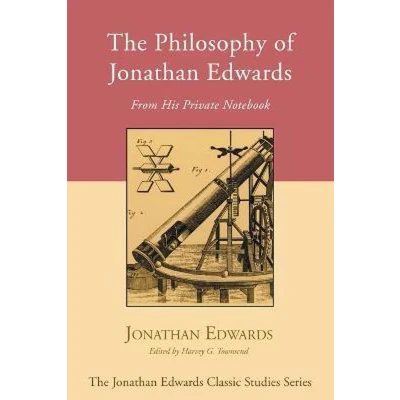
BolOriginally published posthumously in 1955, Harvey G. Townsend's Philosophy of Jonathan Edwards reprinted some of Edwards' most important early compositions on natural philosophy, "Of Being" and "The Mind," and collected nearly two hundred "Miscellanies" entries, some of them published here for the first time. In his introduction, Townsend points to Edwards' "radical idealism" that derived from Christian Platonism and John Locke rather than George Berkeley, as commonly thought. Townsend's work represents an important sourcebook for Edwards' writings, and his introduction presents a clear picture of mainstream Edwards scholarship at the middle of the twentieth century.
 Productspecificaties
| EAN |
|
|---|---|
| Maat |
|
 Prijshistorie
 Prijzen voor het laatst bijgewerkt op:
 Gerelateerde resultaten


