

€ 16,99 Gratis verzending

Uitgelicht
|
|
16,99 |
Naar shop
|

|
16,99 |
Naar shop
|

|
18,83
16,99 |
Naar shop
|
| VERGELIJK ALLE AANBIEDERS (4) | ||
 Beschrijving
Vergelijk aanbieders (4)
€ 16,99 Gratis verzending
€ 16,99 Gratis verzending
€ 18,83 € 16,99 € 2,99 verzendkosten Totaal € 19,98

gebruikt € 21,68 Gratis verzending
Winkels met andere maten
Beschrijving
(2)
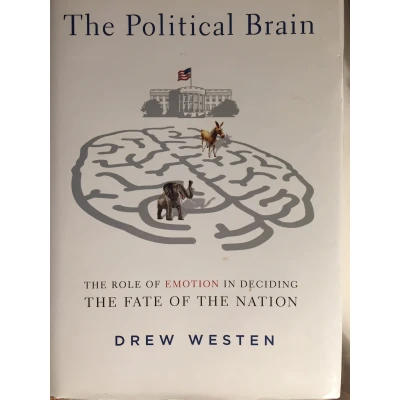
This groundbreaking investigation by a renowned psychologist and neuroscientist proves it: We vote with our hearts, not our minds The Political Brain is a ground-breaking investigation into the role of emotion in determining the political life of the nation. For two decades Drew Westen, professor of psychology and psychiatry at Emory University, has explored a theory of the mind that differs substantially from the more "dispassionate" notions held by most cognitive psychologists, political scientists, and economists,and Democratic campaign strategists. The idea of the mind as a cool calculator that makes decisions by weighing the evidence bears no relation to how the brain actually works. When political candidates assume voters dispassionately make decisions based on "the issues," they lose. That's why only one Democrat has been re-elected to the presidency since Franklin Roosevelt,and only one Republican has failed in that quest. In politics, when reason and emotion collide, emotion invariably wins. Elections are decided in the marketplace of emotions, a marketplace filled with values, images, analogies, moral sentiments, and moving oratory, in which logic plays only a supporting role. Westen shows, through a whistle-stop journey through the evolution of the passionate brain and a bravura tour through fifty years of American presidential and national elections, why campaigns succeed and fail. The evidence is overwhelming that three things determine how people vote, in this order: their feelings toward the parties and their principles, their feelings toward the candidates, and, if they haven't decided by then, their feelings toward the candidates' policy positions. Westen turns conventional political analyses on their head, suggesting that the question for Democratic politics isn't so much about moving to the right or the left but about moving the electorate. He shows how it can be done through examples of what candidates have said,or could have said,in debates, speeches, and ads. Westen's discoveries could utterly transform electoral arithmetic, showing how a different view of the mind and brain leads to a different way of talking with voters about issues that have tied the tongues of Democrats for much of forty years,such as abortion, guns, taxes, and race. You can't change the structure of the brain. But you can change the way you appeal to it. And here's how,
Bol PartnerThis book presents a groundbreaking and surprising scientific investigation into how the mind works, how the brain works and what this means for why candidates win and lose elections. Since the 18th century, the idea of mind that has captured the imagination of philosophers, cognitive scientists, economists and political scientists is of a dispassionate mind that makes decisions by weighing evidence and reasoning to make the most valid conclusions. It bears no relation to how the mind and brain actually work. In this landmark book, Professor Drew Westen - a scientist and psychologist who has led a pioneering investigation into how the brain processes political information - shows through a whirlwind tour of American political leaders how electorates vote not with their heads, but with their hearts. He finds that Americans are a nation of passionate voters, not cool political spectators - they love (or hate) Bill Clinton and George W Bush. No-one else will do. The book, which examines data across several Presidential elections from the 1950s to the present day, is a serious and groundbreaking investigation into the role of emotion in driving voting behaviour.
 Prijshistorie
 * Prijshistorie bevat geen data van Amazon, Amazon Marketplace.
Prijzen voor het laatst bijgewerkt op:
 Gerelateerde resultaten
 Productspecificaties


