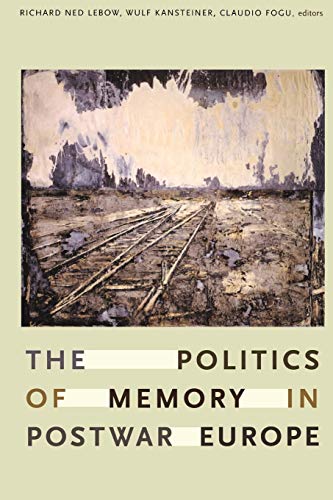
The Politics of Memory in Postwar Europe

Prijzen vanaf
27,49

Uitgelicht

VERGELIJK ALLE AANBIEDERS (3)

Beschrijving

Bol Comparative case studies of how memories of World War II have been constructed and revised in France, Germany, Austria, Switzerland, Poland, Italy, and the USSR (Russia). For sixty years, different groups in Europe have put forth interpretations of World War II and their respective countries’ roles in it consistent with their own political and psychological needs. The conflict over the past has played out in diverse arenas, including film, memoirs, court cases, and textbooks. It has had profound implications for democratization and relations between neighboring countries. This collection provides a comparative case study of how memories of World War II have been constructed and revised in seven European nations: France, Germany, Austria, Switzerland, Poland, Italy, and the USSR (Russia). The contributors include scholars of history, literature, political science, psychology, and sociology. Country by country, they bring to the fore the specifics of each nation’s postwar memories in essays commissioned especially for this volume. The use of similar analytical categories facilitates comparisons. An extensive introduction contains reflections on the significance of Europeans’ memories of World War II and a conclusion provides an analysis of the implications of the contributors’ findings for memory studies. These two pieces tease out some of the findings common to all seven countries: for instance, in each nation, the decade and a half between the late 1960s and the mid-1980s was the period of most profound change in the politics of memory. At the same time, the contributors demonstrate that Europeans understand World War II primarily through national frames of reference, which are surprisingly varied. Memories of the war have important ramifications for the democratization of Central and Eastern Europe and the consolidation of the European Union. This volume clarifies how those memories are formed and institutionalized. Contributors. Claudio Fogu, Richard J. Golsan, Wulf Kansteiner, Richard Ned Lebow, Regula Ludi, Annamaria Orla-Bukowska, Heidemarie Uhl, Thomas C. Wolfe

Vergelijk aanbieders (3)

Shop
Prijs
Verzendkosten
Totale prijs
27,49
Gratis
27,49
Naar shop
Gratis Shipping Costs
27,49
Gratis
27,49
Naar shop
Gratis Shipping Costs
32,62
Gratis
32,62
Naar shop
Gratis Shipping Costs
Beschrijving (2)
Bol

Comparative case studies of how memories of World War II have been constructed and revised in France, Germany, Austria, Switzerland, Poland, Italy, and the USSR (Russia). For sixty years, different groups in Europe have put forth interpretations of World War II and their respective countries’ roles in it consistent with their own political and psychological needs. The conflict over the past has played out in diverse arenas, including film, memoirs, court cases, and textbooks. It has had profound implications for democratization and relations between neighboring countries. This collection provides a comparative case study of how memories of World War II have been constructed and revised in seven European nations: France, Germany, Austria, Switzerland, Poland, Italy, and the USSR (Russia). The contributors include scholars of history, literature, political science, psychology, and sociology. Country by country, they bring to the fore the specifics of each nation’s postwar memories in essays commissioned especially for this volume. The use of similar analytical categories facilitates comparisons. An extensive introduction contains reflections on the significance of Europeans’ memories of World War II and a conclusion provides an analysis of the implications of the contributors’ findings for memory studies. These two pieces tease out some of the findings common to all seven countries: for instance, in each nation, the decade and a half between the late 1960s and the mid-1980s was the period of most profound change in the politics of memory. At the same time, the contributors demonstrate that Europeans understand World War II primarily through national frames of reference, which are surprisingly varied. Memories of the war have important ramifications for the democratization of Central and Eastern Europe and the consolidation of the European Union. This volume clarifies how those memories are formed and institutionalized. Contributors. Claudio Fogu, Richard J. Golsan, Wulf Kansteiner, Richard Ned Lebow, Regula Ludi, Annamaria Orla-Bukowska, Heidemarie Uhl, Thomas C. Wolfe

Amazon

Pagina's: 384, Paperback, Duke University Press


Productspecificaties

Merk Duke University Press
EAN
  • 9780822338178
Maat


Prijshistorie

* Prijshistorie bevat geen data van Amazon, Amazon Marketplace.

Prijzen voor het laatst bijgewerkt op:

Uitgelichte Keuze
27,49
Naar shop
