
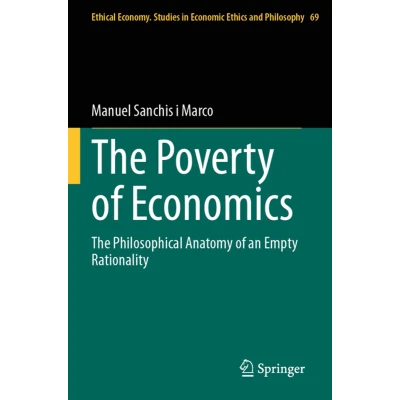
The Poverty of Economics: Philosophical Anatomy an Empty Rationality
Uitgelicht

|
105,00 |
Naar shop
|

|
117,69 |
Naar shop
|

|
117,69 |
Naar shop
|
| VERGELIJK ALLE AANBIEDERS (3) | ||
 Beschrijving
Bol
This book improves the alignment of economics with the idea of justice, the first virtue of any social institution, according to Rawls. In contrast to Robbins' economic rationality, economic choices must be based on adequate and good reasons, as Rescher claims, because both the means and the ends require rational deliberation. This book improves the alignment of economics with the idea of justice, the first virtue of any social institution, according to Rawls. To this aim, it provides the analytical framework necessary to ensure a just economy. While today’s notion of economics favours the economics of extortion, this book proposes a model that transcends Lionel Robbins’ canonical relationship between ends and means, as it proposes a broader notion of rationality incorporating the range of human attributes. In contrast to Robbins' economic rationality, economic choices must be based on adequate and good reasons, as Rescher claims, because both the means and the ends require rational deliberation. As a result, the book challenges Robbins’ hope of turning general concepts like scarcity, costs, etc. into universal economic principles guiding human behavior in a vacuum. It disputes the idea that, through the application of the abstract formulation of economic statements unconnected to reality, economics can be rationalized in a morally neutral space, based on empty rationality. By contrasting the three rival versions of economics —formalism (axiomatic), empiricism (technocratic-consequential), and institutionalism (axio-ideological)— the book shows that it is not possible to switch between them as they refer to segmented mental universes of abstraction.


 Beschrijving
(1)
Beschrijving
(1)
This book improves the alignment of economics with the idea of justice, the first virtue of any social institution, according to Rawls. In contrast to Robbins' economic rationality, economic choices must be based on adequate and good reasons, as Rescher claims, because both the means and the ends require rational deliberation. This book improves the alignment of economics with the idea of justice, the first virtue of any social institution, according to Rawls. To this aim, it provides the analytical framework necessary to ensure a just economy. While today’s notion of economics favours the economics of extortion, this book proposes a model that transcends Lionel Robbins’ canonical relationship between ends and means, as it proposes a broader notion of rationality incorporating the range of human attributes. In contrast to Robbins' economic rationality, economic choices must be based on adequate and good reasons, as Rescher claims, because both the means and the ends require rational deliberation. As a result, the book challenges Robbins’ hope of turning general concepts like scarcity, costs, etc. into universal economic principles guiding human behavior in a vacuum. It disputes the idea that, through the application of the abstract formulation of economic statements unconnected to reality, economics can be rationalized in a morally neutral space, based on empty rationality. By contrasting the three rival versions of economics —formalism (axiomatic), empiricism (technocratic-consequential), and institutionalism (axio-ideological)— the book shows that it is not possible to switch between them as they refer to segmented mental universes of abstraction.
 Productspecificaties
 Prijshistorie
* Prijshistorie bevat geen data van Amazon, Amazon Marketplace.
Prijzen voor het laatst bijgewerkt op:
 Gerelateerde resultaten


