








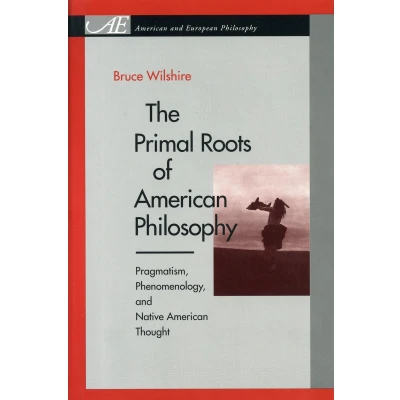
The Primal Roots of American Philosophy
Uitgelicht

|
42,99 |
Naar shop
|
 Beschrijving
Bol
An exploration of American philosophy, connecting the work of such thinkers as Thoreau, Emerson, Dewey and James with Native American beliefs and practices. Bruce Wilshire's search is not for exact parallels, but rather for fundamental affinities. Continuing his quest to bring American philosophy back to its roots, Bruce Wilshire connects the work of such thinkers as Thoreau, Emerson, Dewey, and James with Native American beliefs and practices. His search is not for exact parallels, but rather for fundamental affinities between the equally "organismic" thought systems of indigenous peoples and classic American philosophers. Wilshire gives particular emphasis to the affinities between Black Elk’s view of the hoop of the world and Emerson’s notion of horizon, and also between a shaman’s healing practices and James’s ideas of pure experience, willingness to believe, and a pluralistic universe. As these connections come into focus, the book shows how European phenomenology was inspired and influenced by the classic American philosophers, whose own work reveals the inspiration and influence of indigenous thought. Wilshire’s book also reveals how artificial are the walls that separate the sciences and the humanities in academia, and that separate Continental from Anglo-American thought within the single discipline of philosophy.


Vergelijk aanbieders (1)

 Beschrijving
(1)
Beschrijving
(1)
An exploration of American philosophy, connecting the work of such thinkers as Thoreau, Emerson, Dewey and James with Native American beliefs and practices. Bruce Wilshire's search is not for exact parallels, but rather for fundamental affinities. Continuing his quest to bring American philosophy back to its roots, Bruce Wilshire connects the work of such thinkers as Thoreau, Emerson, Dewey, and James with Native American beliefs and practices. His search is not for exact parallels, but rather for fundamental affinities between the equally "organismic" thought systems of indigenous peoples and classic American philosophers. Wilshire gives particular emphasis to the affinities between Black Elk’s view of the hoop of the world and Emerson’s notion of horizon, and also between a shaman’s healing practices and James’s ideas of pure experience, willingness to believe, and a pluralistic universe. As these connections come into focus, the book shows how European phenomenology was inspired and influenced by the classic American philosophers, whose own work reveals the inspiration and influence of indigenous thought. Wilshire’s book also reveals how artificial are the walls that separate the sciences and the humanities in academia, and that separate Continental from Anglo-American thought within the single discipline of philosophy.
 Productspecificaties
| EAN |
|
|---|---|
| Maat |
|
 Prijshistorie
Prijzen voor het laatst bijgewerkt op:
 Gerelateerde resultaten


