
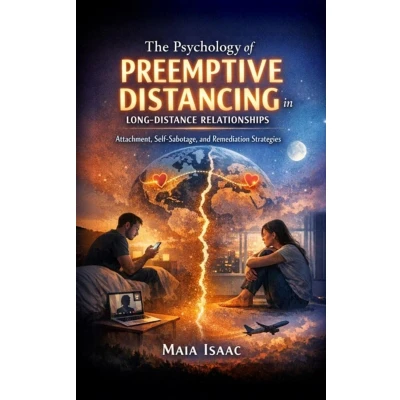
The Psychology of Preemptive Distancing in Long-Distance Relationships
Uitgelicht

|
10,00 |
Naar shop
|

|
26,08 |
Naar shop
|
| VERGELIJK ALLE AANBIEDERS (2) | ||
 Beschrijving
Bol
In the fragile architecture of long-distance love, emotional connection must survive across time zones, screens, and silence. The Psychology of Preemptive Distancing delves into one of the most paradoxical behaviors that emerge under these conditions-the "preemptive strike," when one partner withdraws first to avoid the imagined pain of being left behind. Drawing from attachment theory, neurobiology, and evolutionary psychology, this work exposes how fear of abandonment can masquerade as self-protection while quietly dismantling intimacy.Through a synthesis of cognitive and emotional research, the author traces how distributed intimacy reshapes the human attachment system. The book examines rejection sensitivity, the illusion of control, and the propinquity effect, revealing how distance magnifies every insecurity and distorts the perception of trust. It explores the anatomy of self-sabotage: the rationalization of withdrawal, the erosion of empathy, and the subtle transformation of love into defensive strategy.Yet this is not merely a diagnosis-it is a roadmap for repair. Integrating insights from the Gottman-Rusbult model, trauma differentiation, and clinical interventions, the text offers practical remediation strategies for couples navigating the psychological toll of separation. It invites readers to confront the evolutionary roots of their fears and to reimagine vulnerability as resilience.Written with academic precision and emotional depth, The Psychology of Preemptive Distancing stands as both a scholarly contribution and a compassionate guide for anyone seeking to understand why we sometimes push away the very person we ache to keep close. It is a study of distance, but also of the enduring human desire to bridge it.


 Beschrijving
(1)
Beschrijving
(1)
In the fragile architecture of long-distance love, emotional connection must survive across time zones, screens, and silence. The Psychology of Preemptive Distancing delves into one of the most paradoxical behaviors that emerge under these conditions-the "preemptive strike," when one partner withdraws first to avoid the imagined pain of being left behind. Drawing from attachment theory, neurobiology, and evolutionary psychology, this work exposes how fear of abandonment can masquerade as self-protection while quietly dismantling intimacy.Through a synthesis of cognitive and emotional research, the author traces how distributed intimacy reshapes the human attachment system. The book examines rejection sensitivity, the illusion of control, and the propinquity effect, revealing how distance magnifies every insecurity and distorts the perception of trust. It explores the anatomy of self-sabotage: the rationalization of withdrawal, the erosion of empathy, and the subtle transformation of love into defensive strategy.Yet this is not merely a diagnosis-it is a roadmap for repair. Integrating insights from the Gottman-Rusbult model, trauma differentiation, and clinical interventions, the text offers practical remediation strategies for couples navigating the psychological toll of separation. It invites readers to confront the evolutionary roots of their fears and to reimagine vulnerability as resilience.Written with academic precision and emotional depth, The Psychology of Preemptive Distancing stands as both a scholarly contribution and a compassionate guide for anyone seeking to understand why we sometimes push away the very person we ache to keep close. It is a study of distance, but also of the enduring human desire to bridge it.
 Productspecificaties
 Prijshistorie
* Prijshistorie bevat geen data van Amazon.
Prijzen voor het laatst bijgewerkt op:
 Gerelateerde resultaten


