
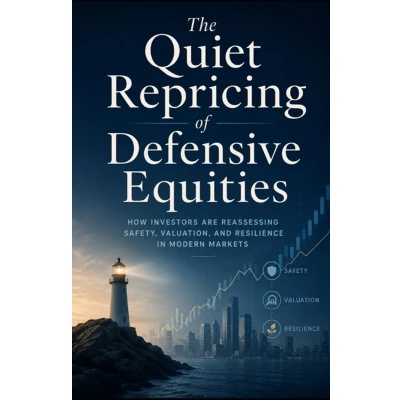
The Quiet Repricing of Defensive Equities: How Investors Are Reassessing Safety, Valuation, and Resilience in Modern Markets
Uitgelicht

|
13,91 |
Naar shop
|

|
13,91 |
Naar shop
|

|
15,00 |
Naar shop
|
| VERGELIJK ALLE AANBIEDERS (3) | ||
 Beschrijving
Bol
The Quiet Repricing of Defensive Equities examines how traditionally defensive sectors-utilities, consumer staples, healthcare, telecommunications, and dividend-paying stocks-have undergone a fundamental reassessment in modern financial markets. For years, exceptionally low interest rates pushed investors toward stable, income-producing companies, causing valuations to rise significantly. Many defensive stocks became "bond proxies," attracting capital from investors seeking yield and safety. The book explains how this environment created historically elevated premiums for stability and why those premiums began to contract as inflation rose, interest rates increased, and investors gained access to attractive alternatives in fixed-income markets.The book explores the economic, mathematical, and behavioral forces behind this repricing. It demonstrates how valuation models, discount rates, dividend yields, and investor psychology interact to influence asset prices. While defensive businesses generally maintained strong fundamentals, many experienced valuation compression because the market changed how it valued future cash flows. The book also examines sector-specific dynamics, including the challenges facing utilities during the energy transition, changing consumer behavior affecting consumer staples companies, healthcare's evolving balance between stability and innovation, and the shifting role of dividend stocks in a higher-yield world. Institutional capital flows, global market developments, and behavioral finance concepts such as loss aversion and the flight to safety are analyzed as major contributors to both the rise and repricing of defensive assets.Ultimately, the book argues that defensive investing remains highly relevant but must be approached differently than in the past. Stability alone no longer guarantees premium valuations. Investors must distinguish between defensive businesses and defensive investments, recognizing that even high-quality companies can generate poor returns when purchased at excessive prices. The future of defensive investing will be shaped by valuation discipline, technological adaptation, demographic trends, sustainability considerations, and a deeper focus on company-specific fundamentals. Rather than treating defensive sectors as automatic safe havens, investors are encouraged to evaluate each opportunity through a balanced framework that considers quality, growth potential, resilience, and price. The repricing of defensive equities is presented not as the end of defensive investing, but as its evolution into a more selective and sophisticated discipline.


 Beschrijving
(1)
Beschrijving
(1)
The Quiet Repricing of Defensive Equities examines how traditionally defensive sectors-utilities, consumer staples, healthcare, telecommunications, and dividend-paying stocks-have undergone a fundamental reassessment in modern financial markets. For years, exceptionally low interest rates pushed investors toward stable, income-producing companies, causing valuations to rise significantly. Many defensive stocks became "bond proxies," attracting capital from investors seeking yield and safety. The book explains how this environment created historically elevated premiums for stability and why those premiums began to contract as inflation rose, interest rates increased, and investors gained access to attractive alternatives in fixed-income markets.The book explores the economic, mathematical, and behavioral forces behind this repricing. It demonstrates how valuation models, discount rates, dividend yields, and investor psychology interact to influence asset prices. While defensive businesses generally maintained strong fundamentals, many experienced valuation compression because the market changed how it valued future cash flows. The book also examines sector-specific dynamics, including the challenges facing utilities during the energy transition, changing consumer behavior affecting consumer staples companies, healthcare's evolving balance between stability and innovation, and the shifting role of dividend stocks in a higher-yield world. Institutional capital flows, global market developments, and behavioral finance concepts such as loss aversion and the flight to safety are analyzed as major contributors to both the rise and repricing of defensive assets.Ultimately, the book argues that defensive investing remains highly relevant but must be approached differently than in the past. Stability alone no longer guarantees premium valuations. Investors must distinguish between defensive businesses and defensive investments, recognizing that even high-quality companies can generate poor returns when purchased at excessive prices. The future of defensive investing will be shaped by valuation discipline, technological adaptation, demographic trends, sustainability considerations, and a deeper focus on company-specific fundamentals. Rather than treating defensive sectors as automatic safe havens, investors are encouraged to evaluate each opportunity through a balanced framework that considers quality, growth potential, resilience, and price. The repricing of defensive equities is presented not as the end of defensive investing, but as its evolution into a more selective and sophisticated discipline.
 Productspecificaties
 Prijshistorie
* Prijshistorie bevat geen data van Amazon, Amazon Marketplace.
Prijzen voor het laatst bijgewerkt op:
 Gerelateerde resultaten


