


€ 53,99 Gratis verzending

Uitgelicht
|
|
53,99 |
Naar shop
|

|
115,28 |
Naar shop
|
| VERGELIJK ALLE AANBIEDERS (2) | ||
 Beschrijving
Vergelijk aanbieders (2)
€ 53,99 Gratis verzending
gebruikt € 115,28 Gratis verzending
Winkels met andere maten
Beschrijving
(2)
This book explores the right to development in international law. The volume draws on a range of relevant sources to analyze the legal status of international cooperation in contemporary international law, before going on to explore the domestic application of the right to development looking at the example of Pakistan. The Right to Development in International Law rigorously explores the right to development (RTD) from the perspectives of international law as well as the constitutionally guaranteed fundamental rights and the Islamic concept of social justice in Pakistan. The volume draws on a wide range of relevant sources to analyse the legal status of international cooperation in contemporary international law, before exploring the domestic application of the right to development looking at the example of Pakistan, a country that is undergoing radical transformation in terms of its internal governance structures and the challenges it faces for enforcing the rule of law. Of particular importance is the examination of the RTD and Shari‘ah law in Pakistan which adds a new perspective to the RTD debate and enriches the discussion about human rights and Shari‘ah across the world. Through focusing on Pakistan the book links international perspectives and the international human rights framework with the domestic constitutional apparatus for enforcing the RTD within that jurisdiction. In doing so, Khurshid Iqbal argues that the RTD may be promoted through existing constitutional mechanisms if fundamental rights are widely interpreted by the superior courts, effectively implemented by the lower courts and if Shari‘ah law is progressively interpreted in public interest. Iqbal’s work will appeal to researchers, professionals and students in the fields of law, human rights, development, international law, South Asian Studies, Islamic law and international development studies.
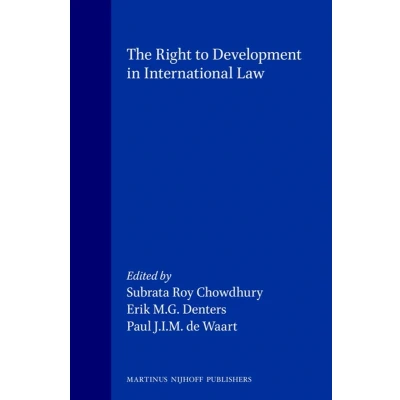
Bol PartnerBased on the papers that were presented at a seminar held in Calcutta, this work focuses on the right to development, in particular its ideas and ideology, human rights aspects and implementation in specific areas of international law. The chapters in this volume are based on the papers that were presented at the Calcutta seminar organized in March 1992 by the ILA Committee on Lehal Aspects of a New International Economic Order (NIEO). The conference focused on the right to development, in particular its ideas and ideology, human rights aspects and implementation in specific areas of international law. The volume is accordingly organized in three parts. The chapters cover a vast area of subjects, derived from the UN Declaration of the Right to Development. From the developed and underdeveloped world 33 authors discuss topics including: contents, scope and implementation of the right to development; human rights of individuals and peoples; co-operation between the European Community and the Lomé IV states; current developments in investments treaties; refugee protection; development and democracy; concept of sustainable development; environmental issues; protection of intellectual property; transfer of technology; human rights in international financial institutions; and the legal conceptualization of the debt crisis. Professor Oscar Schachter observes in the first chapter that the Declaration continues to be a `challenging subject for legal commentary' for its `detable legal status, its combination of collective and individual rights, its expansive conception of development and its equivocal obligation'. Apart from support, doubts about the concept to the right to development may also be found in this volume.
 Productspecificaties
| EAN |
|
|---|---|
| Maat |
|
 Prijshistorie
Prijzen voor het laatst bijgewerkt op:
 Gerelateerde resultaten


