
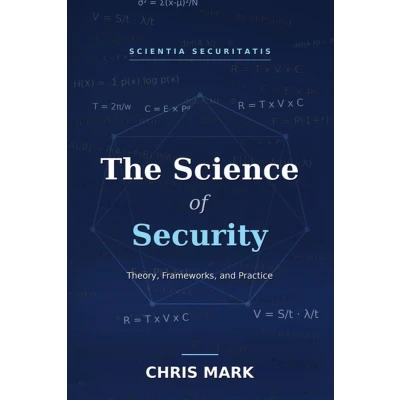
The Science of Security: Scientia Securitatis: Theory, Frameworks, and Practice
Uitgelicht

|
21,16 |
Naar shop
|

|
21,16 |
Naar shop
|

|
22,99 |
Naar shop
|
| VERGELIJK ALLE AANBIEDERS (3) | ||
 Beschrijving
Bol
The security profession has produced thousands of books on tools, threats, and compliance frameworks. Almost none on how to think clearly about the problem.Scientia Securitatis - Latin for "the science of security" - develops the analytical apparatus the field actually needs. Drawing on criminology, cognitive psychology, military theory, and twenty-five years of practitioner experience across physical, cyber, personnel, and operational domains, Chris Mark treats security as a unified discipline whose underlying problems are the same regardless of domain.This is not another cybersecurity book. Whether the threat is pirates trying to hijack a ship, gunfire against an electrical substation in North Carolina, a deepfake CEO impersonation that moves $25 million across borders, the Volt Typhoon and Salt Typhoon campaigns against U.S. critical infrastructure, or an Equifax-style breach blamed on its victim, the analytical questions are constant: Who chose to attack? Why did the defense fail? What would actually have worked?What the book develops: - The Mark Heptad - a taxonomy of seven adversary motivations (financial, espionage, war/defense, facilitation, hacktivism, revenge, nuisance) that maps directly to deterrence strategy- The IMCM Framework - Ignorance, Mistake, Complacency, Malice - for classifying human-induced vulnerabilities and matching them to specific interventions- The DIVE Framework - Direction, Intensity, Vulnerability, Exposure - for operational security assessment- The Multiplicative Security Model - the mathematical basis for why defense-in-depth actually works, and how to calculate it- Rigorous treatments of the Swiss Cheese Model, Routine Activity Theory, Situational Crime Prevention, and the Twenty-Five Techniques- A criminological critique of victim blaming in post-incident analysis, drawn from Wolfgang, Timmer and Norman, and case studies of the Equifax, OPM, Target, and Snowflake breachesWho this book is for: Security executives building defensible programs across multiple domains. Policy professionals confronting unrestricted warfare doctrine and contemporary asymmetric threats. Risk and compliance leaders who suspect compliance frameworks aren't stopping sophisticated adversaries - and want to understand why. Graduate students approaching security as an analytical discipline rather than a job category. Practitioners with the instincts to ask better questions.


 Beschrijving
(1)
Beschrijving
(1)
The security profession has produced thousands of books on tools, threats, and compliance frameworks. Almost none on how to think clearly about the problem.Scientia Securitatis - Latin for "the science of security" - develops the analytical apparatus the field actually needs. Drawing on criminology, cognitive psychology, military theory, and twenty-five years of practitioner experience across physical, cyber, personnel, and operational domains, Chris Mark treats security as a unified discipline whose underlying problems are the same regardless of domain.This is not another cybersecurity book. Whether the threat is pirates trying to hijack a ship, gunfire against an electrical substation in North Carolina, a deepfake CEO impersonation that moves $25 million across borders, the Volt Typhoon and Salt Typhoon campaigns against U.S. critical infrastructure, or an Equifax-style breach blamed on its victim, the analytical questions are constant: Who chose to attack? Why did the defense fail? What would actually have worked?What the book develops: - The Mark Heptad - a taxonomy of seven adversary motivations (financial, espionage, war/defense, facilitation, hacktivism, revenge, nuisance) that maps directly to deterrence strategy- The IMCM Framework - Ignorance, Mistake, Complacency, Malice - for classifying human-induced vulnerabilities and matching them to specific interventions- The DIVE Framework - Direction, Intensity, Vulnerability, Exposure - for operational security assessment- The Multiplicative Security Model - the mathematical basis for why defense-in-depth actually works, and how to calculate it- Rigorous treatments of the Swiss Cheese Model, Routine Activity Theory, Situational Crime Prevention, and the Twenty-Five Techniques- A criminological critique of victim blaming in post-incident analysis, drawn from Wolfgang, Timmer and Norman, and case studies of the Equifax, OPM, Target, and Snowflake breachesWho this book is for: Security executives building defensible programs across multiple domains. Policy professionals confronting unrestricted warfare doctrine and contemporary asymmetric threats. Risk and compliance leaders who suspect compliance frameworks aren't stopping sophisticated adversaries - and want to understand why. Graduate students approaching security as an analytical discipline rather than a job category. Practitioners with the instincts to ask better questions.
 Productspecificaties
 Prijshistorie
* Prijshistorie bevat geen data van Amazon, Amazon Marketplace.
Prijzen voor het laatst bijgewerkt op:
 Gerelateerde resultaten


