
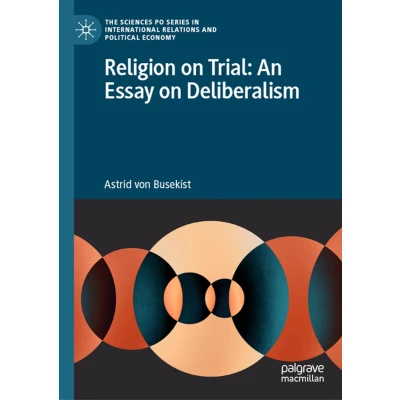
The Sciences Po Series in International Relations and Political Economy Religion on Trial: An Essay Deliberalism
Uitgelicht

|
119,00 |
Naar shop
|
| VERGELIJK ALLE AANBIEDERS (1) | ||
 Beschrijving
Bol
This is a brilliant study of the many instances when religious obligations come into conflict with secular legal principles. In careful case studies of three of those instances – home schooling, circumcision, and divorce – Astrid von Busekist argues that in real life neither the obligations nor the principles are fixed forever, unchanging. She offers a wise argument for pragmatic and contextual resolutions. -Michael Walzer, Professor Emeritus, Institute for Advanced Studies, Princeton University This book examines three distinct modes of interaction between secular law and religious commandments: “separationism,” “composition,” and “cooperation”, and explores how legal practitioners address complex cases through pragmatic reasoning. Its originality lies in grounding the analysis in three real-world scenarios – home-schooling, circumcision, and Jewish divorce (Get) –, each illustrating conflicts between foundational norms belonging to distinct normative frameworks. Rather than asking how liberal constitutionalism should normatively resolve such cases, the author argues that the threshold distinguishing permissible and compatible religious practices must be assessed contextually and pragmatically. The book’s counterintuitive contribution is to demonstrate that, even within the extensively studied field of church-state relations, secularism is a dynamic, evolving practice. Astrid von Busekist is Professor of Political Theory, and Researcher at the Center for International Studies (CERI) at Sciences Po, Paris. She is Head of the Political Theory Program, and Editor of Raisons Politiques. She has written extensively on justice, boundaries, nationalism and language policies. The book deals with three specific encounters between the law and religious commandments: “separationism”, “composition”, and “cooperation” (homeschooling, circumcision, the “Get-laws”), and how legal practitioners handle hard cases on a pragmatic basis. Its distinctiveness might me summarized as follows: The book is based on 3 empirical real-life scenarios (see Introduction) involving confrontations between religious commandments and secular law; conflicts between fundamental principles of different normative orders. Instead of asking how the liberal constitutionalism should normatively handle these cases (as the books and articles of my competitors listed below do), I suggest that the threshold between permissible / compatible religious practices is moving and should be treated contextually and pragmatically. My main claim is that there is not one single version of “secularism” (or “laïcité” in the French context), but a multiplicity of possible dialogues between representatives of faith communities and representatives of the legal / political community. My scenarios show that decisions are guided by a context-specific balance between democratic values, foremost equality and freedom. Sometimes these cardinal values conflict and judges must rank them. The articulation between religion and politics is not stable, not written in advance, not subsumable under a clear rule; legal principles are not hierarchically ordered a priori as all my cases show, even first-order principles (freedom/equality) must sometimes be weighed against each other. I try to theorize each of these pragmatic interactions under the umbrella-concept of “deliberalism” and show that my scenarios display three different types of interaction between orders that range from a strong separation to outright cooperation. The counterintuitive dimension of my book is to say that even in a very well-documented field, (Church and state-relations), secularism is not a thick concept, not a theory, but a practice.


Vergelijk aanbieders (1)

 Beschrijving
(1)
Beschrijving
(1)
This is a brilliant study of the many instances when religious obligations come into conflict with secular legal principles. In careful case studies of three of those instances – home schooling, circumcision, and divorce – Astrid von Busekist argues that in real life neither the obligations nor the principles are fixed forever, unchanging. She offers a wise argument for pragmatic and contextual resolutions. -Michael Walzer, Professor Emeritus, Institute for Advanced Studies, Princeton University This book examines three distinct modes of interaction between secular law and religious commandments: “separationism,” “composition,” and “cooperation”, and explores how legal practitioners address complex cases through pragmatic reasoning. Its originality lies in grounding the analysis in three real-world scenarios – home-schooling, circumcision, and Jewish divorce (Get) –, each illustrating conflicts between foundational norms belonging to distinct normative frameworks. Rather than asking how liberal constitutionalism should normatively resolve such cases, the author argues that the threshold distinguishing permissible and compatible religious practices must be assessed contextually and pragmatically. The book’s counterintuitive contribution is to demonstrate that, even within the extensively studied field of church-state relations, secularism is a dynamic, evolving practice. Astrid von Busekist is Professor of Political Theory, and Researcher at the Center for International Studies (CERI) at Sciences Po, Paris. She is Head of the Political Theory Program, and Editor of Raisons Politiques. She has written extensively on justice, boundaries, nationalism and language policies. The book deals with three specific encounters between the law and religious commandments: “separationism”, “composition”, and “cooperation” (homeschooling, circumcision, the “Get-laws”), and how legal practitioners handle hard cases on a pragmatic basis. Its distinctiveness might me summarized as follows: The book is based on 3 empirical real-life scenarios (see Introduction) involving confrontations between religious commandments and secular law; conflicts between fundamental principles of different normative orders. Instead of asking how the liberal constitutionalism should normatively handle these cases (as the books and articles of my competitors listed below do), I suggest that the threshold between permissible / compatible religious practices is moving and should be treated contextually and pragmatically. My main claim is that there is not one single version of “secularism” (or “laïcité” in the French context), but a multiplicity of possible dialogues between representatives of faith communities and representatives of the legal / political community. My scenarios show that decisions are guided by a context-specific balance between democratic values, foremost equality and freedom. Sometimes these cardinal values conflict and judges must rank them. The articulation between religion and politics is not stable, not written in advance, not subsumable under a clear rule; legal principles are not hierarchically ordered a priori as all my cases show, even first-order principles (freedom/equality) must sometimes be weighed against each other. I try to theorize each of these pragmatic interactions under the umbrella-concept of “deliberalism” and show that my scenarios display three different types of interaction between orders that range from a strong separation to outright cooperation. The counterintuitive dimension of my book is to say that even in a very well-documented field, (Church and state-relations), secularism is not a thick concept, not a theory, but a practice.
 Productspecificaties
| EAN |
|
|---|---|
| Maat |
|
 Prijshistorie
Prijzen voor het laatst bijgewerkt op:
 Gerelateerde resultaten


