
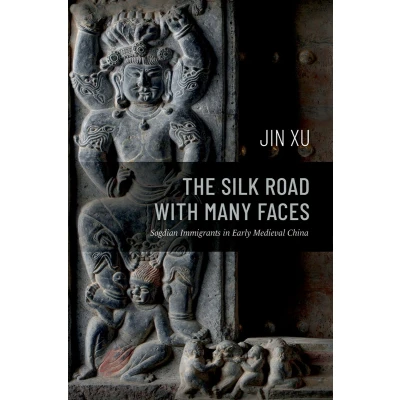
The Silk Road With Many Faces
Uitgelicht

|
105,00 |
Naar shop
|
| VERGELIJK ALLE AANBIEDERS (1) | ||
 Beschrijving
Bol
This book focuses on a distinguished immigrant community in early medieval China (220-589 CE): the Central Asian people known as the Sogdians. Originating in present-day Uzbekistan and Tajikistan, Sogdian merchants dominated the luxury trade along the inland Silk Road from the third to the ninth century, and Sogdian migrants established settlements in all major cities between Central Asia and northern China. Drawing on close analysis of a remarkable group of stone sarcophagi--most of which were excavated over the past three decades--this book reconstructs the multifaceted life experiences of elite Sogdian immigrants active in sixth-century China. Serving as community leaders, these immigrants and their descendants played a central role in the rise of the Sui and Tang dynasties (581-907), an era often celebrated as the golden age of Chinese civilization. Absent from dynastic histories, Sogdian leaders expressed themselves through visual art in ways that transcended ethnic, cultural, and religious boundaries. Their sarcophagi were designed to evoke Central Asian jade, Sasanian silver and gold, and Sogdian patterned silk. In the carved imagery, they are depicted as Chinese sages, the historical Buddha, and participants in the cosmic struggle between good and evil. Their creations functioned as ancestral shrines, stupas, and garden pavilions. Through these means, Sogdian immigrants constructed for themselves, in the afterlife, a paradise with many faces.


Vergelijk aanbieders (1)

 Beschrijving
(1)
Beschrijving
(1)
This book focuses on a distinguished immigrant community in early medieval China (220-589 CE): the Central Asian people known as the Sogdians. Originating in present-day Uzbekistan and Tajikistan, Sogdian merchants dominated the luxury trade along the inland Silk Road from the third to the ninth century, and Sogdian migrants established settlements in all major cities between Central Asia and northern China. Drawing on close analysis of a remarkable group of stone sarcophagi--most of which were excavated over the past three decades--this book reconstructs the multifaceted life experiences of elite Sogdian immigrants active in sixth-century China. Serving as community leaders, these immigrants and their descendants played a central role in the rise of the Sui and Tang dynasties (581-907), an era often celebrated as the golden age of Chinese civilization. Absent from dynastic histories, Sogdian leaders expressed themselves through visual art in ways that transcended ethnic, cultural, and religious boundaries. Their sarcophagi were designed to evoke Central Asian jade, Sasanian silver and gold, and Sogdian patterned silk. In the carved imagery, they are depicted as Chinese sages, the historical Buddha, and participants in the cosmic struggle between good and evil. Their creations functioned as ancestral shrines, stupas, and garden pavilions. Through these means, Sogdian immigrants constructed for themselves, in the afterlife, a paradise with many faces.
 Productspecificaties
| EAN |
|
|---|---|
| Maat |
|
 Prijshistorie
Prijzen voor het laatst bijgewerkt op:
 Gerelateerde resultaten


