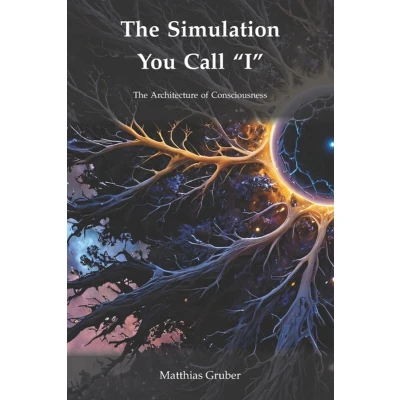
the Simulation You Call “I: Architecture of Consciousness, Computation, and Cosmos
Uitgelicht
|
18,60 |
Naar shop
|
|
18,60 |
Naar shop
|
|
24,99
19,00 |
Naar shop
|
Beschrijving
Bol
You are a simulation. Not a metaphor. Not a philosophical thought experiment. A literal, running simulation - generated by your brain, updated hundreds of times per second, experienced from the inside. A unified theory of consciousness that dissolves the hard problem. This book presents a new theory built on a simple insight: your brain maintains four models - two of the world (one learned, one simulated) and two of the self (one learned, one simulated). The split between these learned and simulated layers is where consciousness lives. Qualia - the redness of red, the taste of coffee, the feeling of being you - are not mysterious. They are the sensory vocabulary of the simulation. What this book does that others don't: - Dissolves the hard problem - not by explaining it away, but by showing it's a category error- Explains psychedelic phenomenology - why DMT dissolves your self but not your world, predicted from first principles- Makes 9 specific, testable predictions - most consciousness theories make zero- Provides a concrete blueprint for building a conscious machine - not philosophy, engineering- Connects consciousness to cosmology - the same computational architecture, from neurons to the universe For readers of Anil Seth, Philip Goff, and Christof Koch - but with something none of them offer: a falsifiable theory with an engineering roadmap. Written by an outsider with a bioinformatics background and no university affiliation, this book started as a 300-page German monograph that sold zero copies. This is the accessible version - shorter, sharper, and aimed at anyone who has ever wondered why anything feels like anything. "If I'm right, consciousness was never mysterious. It was just mislabeled." Includes: 9 testable predictions, a complete neurology reference guide, a lucid dreaming protocol, and the intelligence model that explains why curiosity drives everything. Academic papers under peer review. Preprints freely available on Zenodo (DOI: 10.5281/zenodo.18861613).
AmazonPagina's: 251, Paperback, Independently published
Prijshistorie
* Prijshistorie bevat geen data van Amazon, Amazon Marketplace.
Prijzen voor het laatst bijgewerkt op:

