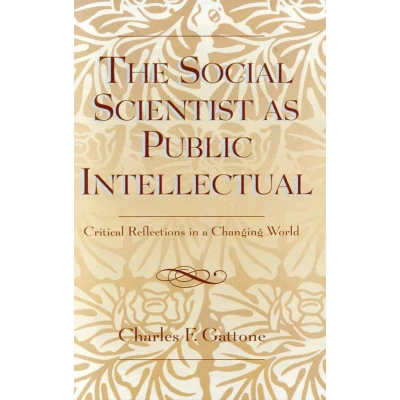

The Social Scientist As Public Intellectual

Prijzen vanaf
28,55

Uitgelicht

VERGELIJK ALLE AANBIEDERS (2)

Beschrijving

Bol Partner Addresses the question of the public role of the social scientist. This book argues that although political and economic institutions influence the course of academic knowledge, opportunities remain for social scientists to act independently of these constraints, and approach their work as public intellectuals. What is the role of the social scientist in public affairs? How have changes in the structure of the university system and the culture of academia reshaped the opportunities and constraints facing contemporary scholars? The Social Scientist as Public Intellectual addresses these and other questions by reviewing the ideas of seminal thinkers in Europe and the United States, and relating their conclusions to today's world. In this book, Charles Gattone examines the analyses of Max Weber, Thorstein Veblen, Karl Mannheim, Joseph Schumpeter, C. Wright Mills, John Kenneth Galbraith, and Pierre Bourdieu, tracing their perspectives through two World wars, the Cold War, and into the present. Gattone situates the ideas of these authors in historical context, showing the ways the realities of their time - fascism , totalitarianism, the rise of bureaucratic institutions, and the expansion of industrial democracy - informed their assessments regarding the place of the intellectual in the political realm. He brings their work into the current context, addressing the difficulties involved in bridging the gap between the ideas of scholarly inquiry and the practical realities of politics, and examining the ways newer factors such as the mass media relate to the character and trajectories of popular sentiment. Gattone argues that although political and economic institutions continue to influence the course of academic knowledge, opportunities remain for social scientists to act independently and develop insight that can ultimately be of value to a wide spectrum of the population in the modern order. Rather than follow the habit of striving to satisfy the narrow demands of institutional supporters, Gattone suggests that social scientists have the potential to approach their work from the standpoint of a broader orientation, and address social issues as public intellectuals.

Vergelijk aanbieders (2)

Shop
Prijs
Verzendkosten
Totale prijs
28,55
gebruikt
Gratis
28,55
Naar shop
Gratis Shipping Costs
32,99
Gratis
32,99
Naar shop
Gratis Shipping Costs
Beschrijving (2)
Bol Partner

Addresses the question of the public role of the social scientist. This book argues that although political and economic institutions influence the course of academic knowledge, opportunities remain for social scientists to act independently of these constraints, and approach their work as public intellectuals. What is the role of the social scientist in public affairs? How have changes in the structure of the university system and the culture of academia reshaped the opportunities and constraints facing contemporary scholars? The Social Scientist as Public Intellectual addresses these and other questions by reviewing the ideas of seminal thinkers in Europe and the United States, and relating their conclusions to today's world. In this book, Charles Gattone examines the analyses of Max Weber, Thorstein Veblen, Karl Mannheim, Joseph Schumpeter, C. Wright Mills, John Kenneth Galbraith, and Pierre Bourdieu, tracing their perspectives through two World wars, the Cold War, and into the present. Gattone situates the ideas of these authors in historical context, showing the ways the realities of their time - fascism , totalitarianism, the rise of bureaucratic institutions, and the expansion of industrial democracy - informed their assessments regarding the place of the intellectual in the political realm. He brings their work into the current context, addressing the difficulties involved in bridging the gap between the ideas of scholarly inquiry and the practical realities of politics, and examining the ways newer factors such as the mass media relate to the character and trajectories of popular sentiment. Gattone argues that although political and economic institutions continue to influence the course of academic knowledge, opportunities remain for social scientists to act independently and develop insight that can ultimately be of value to a wide spectrum of the population in the modern order. Rather than follow the habit of striving to satisfy the narrow demands of institutional supporters, Gattone suggests that social scientists have the potential to approach their work from the standpoint of a broader orientation, and address social issues as public intellectuals.

Bol

In The Social Scientist as Public Intellectual, Charles Gattone addresses the question of the public role of the social scientist by reviewing the work of several key social thinkers, from Max Weber to Pierre Bourdieu. Drawing on the analyses of these scholars, Gattone argues that although political and economic institutions continue to influence the course of academic knowledge, opportunities remain for social scientists to act independently of these constraints, and approach their work as public intellectuals.


Productspecificaties

EAN
  • 9780742537934
  • 9781461645641
Maat


Prijshistorie

Prijzen voor het laatst bijgewerkt op:

Uitgelichte Keuze
28,55
Naar shop
