

€ 9,62 Gratis verzending

Gesponsorde links
|
|
9,62 |
Naar shop
|

|
9,62 |
Naar shop
|

|
10,50 |
Naar shop
|
| VERGELIJK ALLE AANBIEDERS (3) | ||
 Beschrijving
Vergelijk aanbieders (3)
Gesponsorde links · Sommige shops betalen ons een vergoeding
€ 9,62 Gratis verzending
€ 9,62 Gratis verzending
€ 10,50 € 2,99 verzendkosten Totaal € 13,49
Winkels met andere maten
Beschrijving
(1)
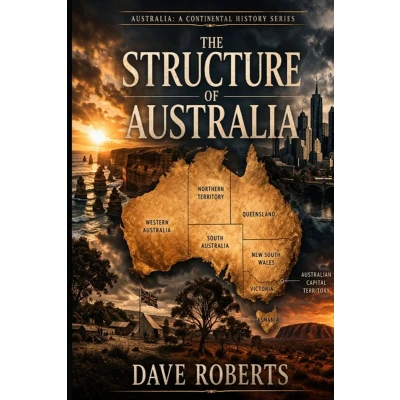
Australia is not one system. It never has been.It is a continent shaped by division-by distance, environment, and the independent systems that formed across it long before federation created the illusion of unity.The Structure of Australia challenges the conventional narrative of a single, coherent nation. Instead, it reveals a deeper reality: Australia as a collection of distinct regional systems, each formed under different pressures, evolving along separate trajectories, and later aligned-not unified-under a federal framework.From the Indigenous systems that first organised the land, to the imposed structure of New South Wales, the economic shock of Victoria's goldfields, the frontier realities of Queensland and the north, the isolation of Western Australia, the planned experiment of South Australia, the transformation of Tasmania, and the construction of the capital system itself-this book traces how Australia developed not as one, but as many.It shows how federation in 1901 did not merge these systems, but created a structure through which they could coexist.Today, those differences remain embedded in the nation's economy, politics, and population-visible in the divide between resource-driven regions and service-based urban centres, in the concentration of power along the east coast, and in the persistent tension between state and federal authority.This is not a history of events.It is an analysis of structure.Inside this book: - The environmental fragmentation that prevented early unity- The rise of independent colonial systems across the continent- How gold, distance, and climate reshaped regional power- The creation of the federal system-and its limitations- The emergence of competing economies within one nation- Why modern Australia functions as a stabilised fragmented systemAustralia did not evolve into a unified structure.It became a system of systems.For readers of history, geopolitics, and structural analysis, this book offers a new way to understand Australia-not as a single story, but as a complex framework built on division, adaptation, and alignment. This book forms part of the broader Australia: A Continental History collection, a series examining the development of the continent from its earliest foundations to the modern era. Each volume stands independently, while contributing to a deeper understanding of Australia's structure, history, and transformation.
 Prijshistorie
* Prijshistorie bevat geen data van Amazon, Amazon Marketplace.
Prijzen voor het laatst bijgewerkt op:
 Gerelateerde resultaten
 Productspecificaties


