

€ 17,85 Gratis verzending

Uitgelicht
|
|
17,85 |
Naar shop
|

|
17,85 |
Naar shop
|

|
18,00 |
Naar shop
|
| VERGELIJK ALLE AANBIEDERS (3) | ||
 Beschrijving
Vergelijk aanbieders (3)
€ 17,85 Gratis verzending
€ 17,85 Gratis verzending
€ 18,00 € 2,99 verzendkosten Totaal € 20,99
Winkels met andere maten
Beschrijving
(1)
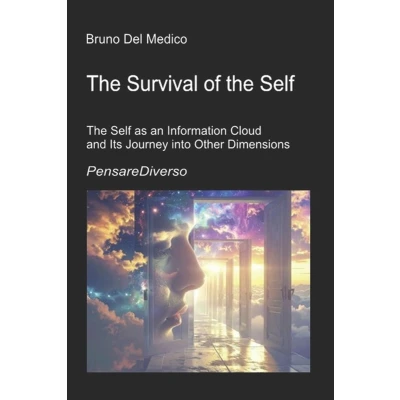
The Survival of the Self puts forward a radical and fascinating thesis: what we call the "self" is not a solid entity destined to dissolve with biological death, but an informational cloud-a dynamic configuration of experiences, memories, and lived collapses-that can survive the loss of the body and continue its journey in other dimensions of reality. The book begins with the crisis of the classical self: the intuitive idea of a unitary subject, located in the brain and coinciding with the body, is proving increasingly incompatible with the findings of contemporary physics and with the unsolved problem of consciousness. If matter itself is not fundamental but emerges from fields, processes, and relationships, then personal identity must also be rethought as an informational process, not as a substance. At the heart of the work lies the principle of conservation of information, which is now crucial in theoretical physics, cosmology, and the study of black holes. Nothing is truly destroyed: what changes is the form, the accessibility, and the level of organization. This insight is extended to subjective experience: every experience leaves a real trace, an informational imprint that cannot simply be annihilated. On this basis, the book tackles the great enigma of consciousness, interpreting it not as a byproduct of the brain, but as a fundamental event: an act, an experienced collapse. The main theories of quantum consciousness are discussed without mystical digressions, but as serious attempts to explain why experience exists and cannot be reduced to pure neural activity. The brain thus appears as a local medium, a temporary interface, not as the ultimate origin of the self. The theoretical core of the work is the notion of "the self as an informational cloud" a non-unitary structure, composed of multiple levels (experiential, emotional, mnemonic, narrative), which evolves over time. Upon biological death, this cloud is not destroyed but separates from its bodily medium. What may dissolve is the narrative ego; what may survive is the field of experience and lived information. In its openly speculative yet conceptually rigorous section, the book explores the hypothesis of a multidimensional universe in which the informational cloud of the self can transition to other modes of existence, characterized by nonlinear time, diffuse identity, and new forms of experiential continuity. Not a single "afterlife," but many possible transitions. The work concludes with the existential implications of this vision: if nothing we experience is ontologically in vain, then living does not mean accumulating or saving oneself, but rather participating responsibly in a broader process. The ego does not survive. What survives is what we have truly experienced.
 Prijshistorie
 * Prijshistorie bevat geen data van Amazon, Amazon Marketplace.
Prijzen voor het laatst bijgewerkt op:
 Gerelateerde resultaten
 Productspecificaties


