
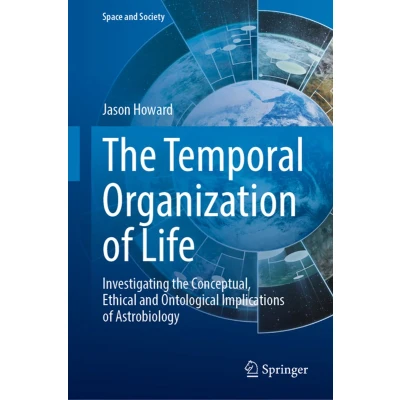
the Temporal Organization of Life: Investigating Conceptual, Ethical and Cosmological Implications Astrobiology
Uitgelicht

|
148,55 |
Naar shop
|

|
148,55 |
Naar shop
|

|
149,00 |
Naar shop
|
| VERGELIJK ALLE AANBIEDERS (3) | ||
 Beschrijving
Bol
One of the more contentious questions to emerge into scientific prominence has been whether life is prevalent in the cosmos. Although there are many factors that shape this debate, one of the most overlooked yet crucial rests on the temporal organization in biotic systems. In this work the author investigates the compatibility and incompatibility between the thermodynamic arrow of time indicative of abiotic structure, and the temporal organization so characteristic of biotic processes and uses it to explore the origins of life here and elsewhere. Far from a minor problem, the author argues that the temporal organization in biotic systems plays a key role in shaping not only the prevalence of life, but also in grounding the scientific theories we use to explain the universe and the moral concepts that will anchor our exploration of the larger cosmos. One of the more contentious debates to emerge into scientific prominence has been whether life is prevalent in the cosmos and its level of complexity. The author of this book argues that, of the many factors that shape this debate, one of the most overlooked yet crucial rests on the different roles that temporal organization plays in biotic systems. Further, the author claims that, although the origin and evolution of life is dependent on the arrow of time, rooted in entropy, the traditional understanding of time’s arrow alone is insufficient to account for the diverse types of temporal processes characteristic of living organisms; most notably, the diverse functions played by past-present-future in shaping biotic systems. Far from a minor problem, he argues that the forms of temporal (bio-tensed) organization utilized by biotic systems shape not only the emergence and prevalence of all life, but also the scientific theories we use to explain the universe along with the moral concepts that inform our responsibilities to extraterrestrial life (should we find any). Drawing from philosophy, the life sciences and astrobiology, this book claims that understanding the centrality of temporality for living systems provides crucial insights that help answer the epistemological, ethical and ontological challenges that face astrobiology’s search for the origins and prevalence of life in the universe.


 Beschrijving
(1)
Beschrijving
(1)
One of the more contentious questions to emerge into scientific prominence has been whether life is prevalent in the cosmos. Although there are many factors that shape this debate, one of the most overlooked yet crucial rests on the temporal organization in biotic systems. In this work the author investigates the compatibility and incompatibility between the thermodynamic arrow of time indicative of abiotic structure, and the temporal organization so characteristic of biotic processes and uses it to explore the origins of life here and elsewhere. Far from a minor problem, the author argues that the temporal organization in biotic systems plays a key role in shaping not only the prevalence of life, but also in grounding the scientific theories we use to explain the universe and the moral concepts that will anchor our exploration of the larger cosmos. One of the more contentious debates to emerge into scientific prominence has been whether life is prevalent in the cosmos and its level of complexity. The author of this book argues that, of the many factors that shape this debate, one of the most overlooked yet crucial rests on the different roles that temporal organization plays in biotic systems. Further, the author claims that, although the origin and evolution of life is dependent on the arrow of time, rooted in entropy, the traditional understanding of time’s arrow alone is insufficient to account for the diverse types of temporal processes characteristic of living organisms; most notably, the diverse functions played by past-present-future in shaping biotic systems. Far from a minor problem, he argues that the forms of temporal (bio-tensed) organization utilized by biotic systems shape not only the emergence and prevalence of all life, but also the scientific theories we use to explain the universe along with the moral concepts that inform our responsibilities to extraterrestrial life (should we find any). Drawing from philosophy, the life sciences and astrobiology, this book claims that understanding the centrality of temporality for living systems provides crucial insights that help answer the epistemological, ethical and ontological challenges that face astrobiology’s search for the origins and prevalence of life in the universe.
 Productspecificaties
 Prijshistorie
* Prijshistorie bevat geen data van Amazon, Amazon Marketplace.
Prijzen voor het laatst bijgewerkt op:
 Gerelateerde resultaten


