








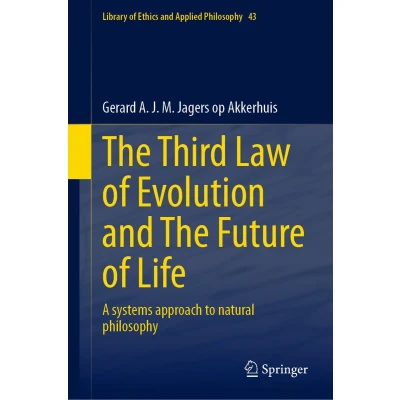
The Third Law of Evolution and Future Life: A systems approach to natural philosophy: 43
Uitgelicht

|
155,00 |
Naar shop
|
 Beschrijving
Bol
This book offers a step-by-step introduction to an integrated theory of physical and biological evolution, from the early universe to the world we know today. In this way, the author develops a basic framework for thinking about evolution, which can be applied to current debates in various research fields. This book offers a step-by-step introduction to an integrated theory of physical and biological evolution, from the early universe to the world we know today. To this end, the well-known laws of variation and selection are supplemented by a third law. This law describes the increase in complexity based on the transitions from quarks to hadrons, to atoms, to molecules, to bacteria, to eukaryotic cells, and so on. These insights revolutionize existing theoretical frameworks for analyzing organization in nature, accelerating developments in natural philosophy. In this way, the author develops a basic framework for thinking about evolution, which can be applied to current debates in various research fields. For example, the new approach finally helps to find the systems-based definitions of organism and life that have been sought for so long. By extrapolating the framework one can even hypothesize about future evolution and our place as humans in it. An exciting read for both philosophers and scientists. This book offers a step-by-step introduction to an integrated theory of physical and biological evolution, from the early universe to the world we know today. To this end, the well-known laws of variation and selection are supplemented by a third law. This law describes the increase in complexity based on the transitions from quarks to hadrons, to atoms, to molecules, to bacteria, to eukaryotic cells, and so on. These insights revolutionize existing theoretical frameworks for analyzing organization in nature, accelerating developments in natural philosophy. In this way, the author develops a basic framework for thinking about evolution, which can be applied to current debates in various research fields. For example, the new approach finally helps to find the systems-based definitions of organism and life that have been sought for so long. By extrapolating the framework one can even hypothesize about future evolution and our place as humans in it. An exciting read for both philosophers and scientists.


Vergelijk aanbieders (1)

 Beschrijving
(1)
Beschrijving
(1)
This book offers a step-by-step introduction to an integrated theory of physical and biological evolution, from the early universe to the world we know today. In this way, the author develops a basic framework for thinking about evolution, which can be applied to current debates in various research fields. This book offers a step-by-step introduction to an integrated theory of physical and biological evolution, from the early universe to the world we know today. To this end, the well-known laws of variation and selection are supplemented by a third law. This law describes the increase in complexity based on the transitions from quarks to hadrons, to atoms, to molecules, to bacteria, to eukaryotic cells, and so on. These insights revolutionize existing theoretical frameworks for analyzing organization in nature, accelerating developments in natural philosophy. In this way, the author develops a basic framework for thinking about evolution, which can be applied to current debates in various research fields. For example, the new approach finally helps to find the systems-based definitions of organism and life that have been sought for so long. By extrapolating the framework one can even hypothesize about future evolution and our place as humans in it. An exciting read for both philosophers and scientists. This book offers a step-by-step introduction to an integrated theory of physical and biological evolution, from the early universe to the world we know today. To this end, the well-known laws of variation and selection are supplemented by a third law. This law describes the increase in complexity based on the transitions from quarks to hadrons, to atoms, to molecules, to bacteria, to eukaryotic cells, and so on. These insights revolutionize existing theoretical frameworks for analyzing organization in nature, accelerating developments in natural philosophy. In this way, the author develops a basic framework for thinking about evolution, which can be applied to current debates in various research fields. For example, the new approach finally helps to find the systems-based definitions of organism and life that have been sought for so long. By extrapolating the framework one can even hypothesize about future evolution and our place as humans in it. An exciting read for both philosophers and scientists.
 Productspecificaties
| EAN |
|
|---|---|
| Maat |
|
 Prijshistorie
Prijzen voor het laatst bijgewerkt op:
 Gerelateerde resultaten


