


€ 35,99 Gratis verzending

Gesponsorde links
|
|
35,99 |
Naar shop
|

|
36,90 |
Naar shop
|

|
36,90 |
Naar shop
|
| VERGELIJK ALLE AANBIEDERS (3) | ||
 Beschrijving
Vergelijk aanbieders (3)
Gesponsorde links · Sommige shops betalen ons een vergoeding
€ 35,99 Gratis verzending
€ 36,90 Gratis verzending
€ 36,90 Gratis verzending
Winkels met andere maten
Beschrijving
(1)
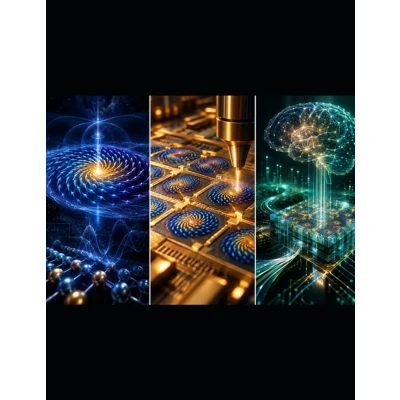
THE SKYRMION COMPUTER Spatial Computing, Analog In-Memory Processing, and the 1-MiB Skyrmion AcceleratorWhat happens when memory stops being a place where computation waits-and becomes part of the computation itself?For decades, computers have treated memory and processing as distinct physical functions. The Skyrmion Computer explores a radically different possibility: building computation around persistent magnetic states whose spatial configuration can directly participate in information processing.This is Volume III of The Topological Spin Computing Series, the culmination of a journey from fundamental spin physics to engineered magnetic devices and finally to a proposed system architecture.The book develops the path from spatially encoded weights and analog vector-matrix multiplication to digital-to-analog interfaces, hardware-aware learning, dense-array dynamics, thermal constraints, system-level energy accounting, and the proposed 1-MiB Skyrmion APU. The underlying manuscript explicitly brings these elements together across Chapters 23-30.But the central question is larger than the device: Can the physical medium that stores information also perform the computation?The answer cannot be established by a single impressive device number. It requires a system in which memory, state, analog computation, conversion, control, reliability, and energy are considered together.That is the challenge this volume takes on.The result is not a claim that a skyrmion computer has already replaced conventional hardware. It is a proposed architectural framework for examining what such a machine would require-and whether the physical advantages of topological information can survive all the way to the system level.Volume I established the physics. Volume II engineered the memory. Volume III asks the decisive question: Can the memory become the computer?From magnetic texture to computational state, from computational state to matrix operation, and from matrix operation to accelerator, The Skyrmion Computer offers a view of computing in which information is not merely represented by matter.Matter participates in the calculation.This book is aimed at readers working across neuromorphic computing, AI hardware, in-memory computing, spintronics, analog accelerators, emerging architectures, and advanced device engineering.
 Prijshistorie
* Prijshistorie bevat geen data van Amazon, Amazon Marketplace.
Prijzen voor het laatst bijgewerkt op:
 Gerelateerde resultaten
 Productspecificaties


