
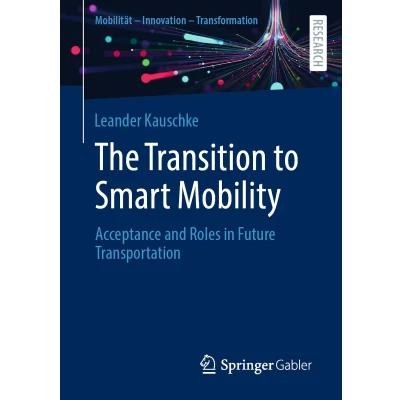
The Transition to Smart Mobility: Acceptance and Roles in Future Transportation
Uitgelicht

|
99,99 |
Naar shop
|
| VERGELIJK ALLE AANBIEDERS (1) | ||
 Beschrijving
Bol
Present book thus offers an in-depth look at the variables involved in the equation of smart mobility acceptance (1) and envisaged institutional change (2). Both views are embedded in the Multi-Level Perspective. Most contemporary notions of the fairly recent concept ‘smart mobility’ portray an imminent transition of similar socio-economic consequences as the shift from horses to automobiles did 100 years ago. Present book thus offers an in-depth look at the variables involved in the equation of smart mobility acceptance (1) and envisaged institutional change (2). Both views are embedded in the Multi-Level Perspective. Study 1 develops a structural equation model in SmartPLS. Use cases cover eBikes (N=537), mobility-as-a-service (N=531), and fully automated vehicles (N=558). Based on the results, acceptance relies on five factors: performance expectancy, facilitating conditions, social influence, habit, and hedonic motivation.Study 2 applies the Institutional Role Model (IRM) to better understand system dynamics. Thus, the smart mobility ecosystem is mapped in a structured manner. It identifies nine institutions, as well as four technical and four economic roles. Results of interviews with experts (N=8) support the IRM’s significance as a vision provider for a new mobility regime. In the end, these two perspectives amalgamate. This opens a sophisticated space for public debate about the commencing transition to smart mobility. About the author Leander Kauschke conducts research on issues related to the mobility of the future. He is particularly interested in problems that arise at the crossroads of politics, business and society and transcend purely technological considerations. Most contemporary notions of the fairly recent concept ‘smart mobility’ portray an imminent transition of similar socio-economic consequences as the shift from horses to automobiles did 100 years ago. Present book thus offers an in-depth look at the variables involved in the equation of smart mobility acceptance (1) and envisaged institutional change (2). Both views are embedded in the Multi-Level Perspective. Study 1 develops a structural equation model in SmartPLS. Use cases cover eBikes (N=537), mobility-as-a-service (N=531), and fully automated vehicles (N=558). Based on the results, acceptance relies on five factors: performance expectancy, facilitating conditions, social influence, habit, and hedonic motivation.Study 2 applies the Institutional Role Model (IRM) to better understand system dynamics. Thus, the smart mobility ecosystem is mapped in a structured manner. It identifies nine institutions, as well as four technical and four economic roles. Results of interviews with experts (N=8) support the IRM’s significance as a vision provider for a new mobility regime. In the end, these two perspectives amalgamate. This opens a sophisticated space for public debate about the commencing transition to smart mobility.


Vergelijk aanbieders (1)

 Beschrijving
(1)
Beschrijving
(1)
Present book thus offers an in-depth look at the variables involved in the equation of smart mobility acceptance (1) and envisaged institutional change (2). Both views are embedded in the Multi-Level Perspective. Most contemporary notions of the fairly recent concept ‘smart mobility’ portray an imminent transition of similar socio-economic consequences as the shift from horses to automobiles did 100 years ago. Present book thus offers an in-depth look at the variables involved in the equation of smart mobility acceptance (1) and envisaged institutional change (2). Both views are embedded in the Multi-Level Perspective. Study 1 develops a structural equation model in SmartPLS. Use cases cover eBikes (N=537), mobility-as-a-service (N=531), and fully automated vehicles (N=558). Based on the results, acceptance relies on five factors: performance expectancy, facilitating conditions, social influence, habit, and hedonic motivation.Study 2 applies the Institutional Role Model (IRM) to better understand system dynamics. Thus, the smart mobility ecosystem is mapped in a structured manner. It identifies nine institutions, as well as four technical and four economic roles. Results of interviews with experts (N=8) support the IRM’s significance as a vision provider for a new mobility regime. In the end, these two perspectives amalgamate. This opens a sophisticated space for public debate about the commencing transition to smart mobility. About the author Leander Kauschke conducts research on issues related to the mobility of the future. He is particularly interested in problems that arise at the crossroads of politics, business and society and transcend purely technological considerations. Most contemporary notions of the fairly recent concept ‘smart mobility’ portray an imminent transition of similar socio-economic consequences as the shift from horses to automobiles did 100 years ago. Present book thus offers an in-depth look at the variables involved in the equation of smart mobility acceptance (1) and envisaged institutional change (2). Both views are embedded in the Multi-Level Perspective. Study 1 develops a structural equation model in SmartPLS. Use cases cover eBikes (N=537), mobility-as-a-service (N=531), and fully automated vehicles (N=558). Based on the results, acceptance relies on five factors: performance expectancy, facilitating conditions, social influence, habit, and hedonic motivation.Study 2 applies the Institutional Role Model (IRM) to better understand system dynamics. Thus, the smart mobility ecosystem is mapped in a structured manner. It identifies nine institutions, as well as four technical and four economic roles. Results of interviews with experts (N=8) support the IRM’s significance as a vision provider for a new mobility regime. In the end, these two perspectives amalgamate. This opens a sophisticated space for public debate about the commencing transition to smart mobility.
 Productspecificaties
| EAN |
|
|---|---|
| Maat |
|
 Prijshistorie
Prijzen voor het laatst bijgewerkt op:
 Gerelateerde resultaten


