








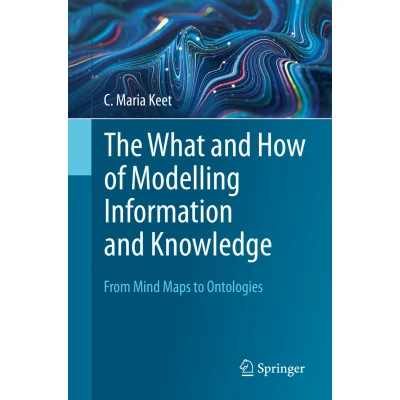
The What and How of Modelling Information Knowledge: From Mind Maps to Ontologies
Uitgelicht

|
66,99 |
Naar shop
|

|
66,99 |
Naar shop
|

|
78,99 |
Naar shop
|
 Beschrijving
Bol
The book draws ideas and transferrable approaches from the plethora of types of models and the methods, techniques, tools, procedures, and methodologies to create them in computer science. This book covers five principal declarative modelling approaches to model information and knowledge for different, yet related, purposes. The main aim of this book is to introduce a group of models and modelling of information and knowledge comprehensibly. Such models and the processes for how to create them help to improve the skills to analyse and structure thoughts and ideas, to become more precise, to gain a deeper understanding of the matter being modelled, and to assist with specific tasks where modelling helps, such as reading comprehension and summarisation of text. The book draws ideas and transferrable approaches from the plethora of types of models and the methods, techniques, tools, procedures, and methodologies to create them in computer science. This book covers five principal declarative modelling approaches to model information and knowledge for different, yet related, purposes. It starts with entry-level mind mapping, to proceed to biological models and diagrams, onward to conceptual data models in software development, and from there to ontologies in artificial intelligence and all the way to ontologyin philosophy. Each successive chapter about a type of model solves limitations of the preceding one and turns up the analytical skills a notch. These what-and-how for each type of model is followed by an integrative chapter that ties them together, comparing their strengths and key characteristics, ethics in modelling, and how to design a modelling language. In so doing, we’ll address key questions such as: what type of models are there? How do you build one? What can you do with a model? Which type of model is best for what purpose? Why do all that modelling? The intended audience for this book is professionals, students, and academics in disciplines where systematic information modelling and knowledge representation is much less common than in computing, such as in commerce, biology, law, and humanities. And if a computer science student or a software developer needs a quick refresher on conceptual data models or a short solid overview of ontologies, then this book will servethem well. The main aim of this book is to introduce a group of models and modelling of information and knowledge comprehensibly. Such models and the processes for how to create them help to improve the skills to analyse and structure thoughts and ideas, to become more precise, to gain a deeper understanding of the matter being modelled, and to assist with specific tasks where modelling helps, such as reading comprehension and summarisation of text. The book draws ideas and transferrable approaches from the plethora of types of models and the methods, techniques, tools, procedures, and methodologies to create them in computer science. This book covers five principal declarative modelling approaches to model information and knowledge for different, yet related, purposes. It starts with entry-level mind mapping, to proceed to biological models and diagrams, onward to conceptual data models in software development, and from there to ontologies in artificial intelligence and all the way to ontology in philosophy. Each successive chapter about a type of model solves limitations of the preceding one and turns up the analytical skills a notch. These what-and-how for each type of model is followed by an integrative chapter that ties them together, comparing their strengths and key characteristics, ethics in modelling, and how to design a modelling language. In so doing, we’ll address key questions such as: what type of models are there? How do you build one? What can you do with a model? Which type of model is best for what purpose? Why do all that modelling? The intended audience for this book is professionals, students, and academics in disciplines where systematic information modelling and knowledge representation is much less common than in computing, such as in commerce, biology, law, and humanities. And if a computer science student or a software developer needs a quick refresher on conceptual data models or a short solid overview of ontologies, then this book will serve them well.


 Beschrijving
(2)
Beschrijving
(2)
The book draws ideas and transferrable approaches from the plethora of types of models and the methods, techniques, tools, procedures, and methodologies to create them in computer science. This book covers five principal declarative modelling approaches to model information and knowledge for different, yet related, purposes. The main aim of this book is to introduce a group of models and modelling of information and knowledge comprehensibly. Such models and the processes for how to create them help to improve the skills to analyse and structure thoughts and ideas, to become more precise, to gain a deeper understanding of the matter being modelled, and to assist with specific tasks where modelling helps, such as reading comprehension and summarisation of text. The book draws ideas and transferrable approaches from the plethora of types of models and the methods, techniques, tools, procedures, and methodologies to create them in computer science. This book covers five principal declarative modelling approaches to model information and knowledge for different, yet related, purposes. It starts with entry-level mind mapping, to proceed to biological models and diagrams, onward to conceptual data models in software development, and from there to ontologies in artificial intelligence and all the way to ontologyin philosophy. Each successive chapter about a type of model solves limitations of the preceding one and turns up the analytical skills a notch. These what-and-how for each type of model is followed by an integrative chapter that ties them together, comparing their strengths and key characteristics, ethics in modelling, and how to design a modelling language. In so doing, we’ll address key questions such as: what type of models are there? How do you build one? What can you do with a model? Which type of model is best for what purpose? Why do all that modelling? The intended audience for this book is professionals, students, and academics in disciplines where systematic information modelling and knowledge representation is much less common than in computing, such as in commerce, biology, law, and humanities. And if a computer science student or a software developer needs a quick refresher on conceptual data models or a short solid overview of ontologies, then this book will servethem well. The main aim of this book is to introduce a group of models and modelling of information and knowledge comprehensibly. Such models and the processes for how to create them help to improve the skills to analyse and structure thoughts and ideas, to become more precise, to gain a deeper understanding of the matter being modelled, and to assist with specific tasks where modelling helps, such as reading comprehension and summarisation of text. The book draws ideas and transferrable approaches from the plethora of types of models and the methods, techniques, tools, procedures, and methodologies to create them in computer science. This book covers five principal declarative modelling approaches to model information and knowledge for different, yet related, purposes. It starts with entry-level mind mapping, to proceed to biological models and diagrams, onward to conceptual data models in software development, and from there to ontologies in artificial intelligence and all the way to ontology in philosophy. Each successive chapter about a type of model solves limitations of the preceding one and turns up the analytical skills a notch. These what-and-how for each type of model is followed by an integrative chapter that ties them together, comparing their strengths and key characteristics, ethics in modelling, and how to design a modelling language. In so doing, we’ll address key questions such as: what type of models are there? How do you build one? What can you do with a model? Which type of model is best for what purpose? Why do all that modelling? The intended audience for this book is professionals, students, and academics in disciplines where systematic information modelling and knowledge representation is much less common than in computing, such as in commerce, biology, law, and humanities. And if a computer science student or a software developer needs a quick refresher on conceptual data models or a short solid overview of ontologies, then this book will serve them well.
AmazonPagina's: 191, Editie: 1st ed. 2023, Paperback, Springer
 Productspecificaties
 Prijshistorie
* Prijshistorie bevat geen data van Amazon, Amazon Marketplace.
Prijzen voor het laatst bijgewerkt op:
 Gerelateerde resultaten


