
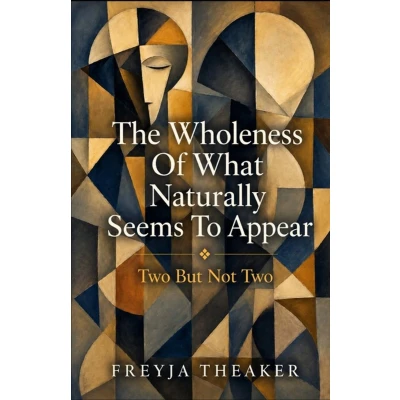
The Wholeness Of What Naturally Seems To Appear: Two But Not
Uitgelicht

|
14,00 |
Naar shop
|

|
14,96 |
Naar shop
|

|
14,96 |
Naar shop
|
| VERGELIJK ALLE AANBIEDERS (3) | ||
 Beschrijving
Bol
What could be more naturally whole than the wholeness of what naturally seems to appear?For thousands of years, human teachers and traditions have, in one way or another, attempted to communicate something about wholeness and what has more recently come to be called non-duality. Many different descriptions, teachings, practices and explanations have naturally appeared.The Wholeness Of What Naturally Seems To Appear: Two But Not Two begins somewhere simpler.Rather than beginning with an explanation of what reality ultimately is, it allows, in a manner of speaking, what naturally seems to appear to speak for itself.Thoughts, feelings, sensations, perceptions, people, objects, events, the world, awareness and whatever else may naturally seem to appear are self-evidently appearing. What naturally seems to appear is not self-evidently nothing. It is already fully itself. Nothing is self-evidently missing from it.And yet there may seem to be someone separate within it: an individual located somewhere within a world, experiencing life as happening to them. With this apparent separation may come seeking - for happiness, security, meaning, enlightenment, completion, or simply for things to be different from how they are.But is this separate individual itself self-evident?Is the apparent division between subject and object, knower and known, awareness and appearance, as self-evidently established as it may seem?And does the wholeness of what naturally seems to appear need to be known, recognised, understood or attained in order already to be whole?Across twenty-five concise chapters, Freyja Theaker explores a series of simple declarations about what is - and is not - self-evident about what naturally seems to appear.These declarations may have a deconstructive quality. Rather than attempting to prove non-duality or replace one explanation of reality with another, the book examines what seems to establish separation. What appears to challenge self-evident wholeness may cease to seem self-evidently established.In this sense, the book is descriptive rather than prescriptive. It offers no method for overcoming separation and no path towards becoming whole. Yet as what seems to establish separation is explored, the apparent experience of separation may itself cease.Nothing new needs to be discovered for what was already self-evident to be self-evident.Nor does the book turn away from human life. Thinking, feeling, choosing, seeking, relationship, suffering, creativity, practices, ritual and the apparent experience of separation are themselves included within the wholeness of what naturally seems to appear.No new belief is required. No particular practice is prescribed. And no final explanation of what reality ultimately is needs to be accepted.Nothing is self-evidently missing.Two, but not two.


 Beschrijving
(1)
Beschrijving
(1)
What could be more naturally whole than the wholeness of what naturally seems to appear?For thousands of years, human teachers and traditions have, in one way or another, attempted to communicate something about wholeness and what has more recently come to be called non-duality. Many different descriptions, teachings, practices and explanations have naturally appeared.The Wholeness Of What Naturally Seems To Appear: Two But Not Two begins somewhere simpler.Rather than beginning with an explanation of what reality ultimately is, it allows, in a manner of speaking, what naturally seems to appear to speak for itself.Thoughts, feelings, sensations, perceptions, people, objects, events, the world, awareness and whatever else may naturally seem to appear are self-evidently appearing. What naturally seems to appear is not self-evidently nothing. It is already fully itself. Nothing is self-evidently missing from it.And yet there may seem to be someone separate within it: an individual located somewhere within a world, experiencing life as happening to them. With this apparent separation may come seeking - for happiness, security, meaning, enlightenment, completion, or simply for things to be different from how they are.But is this separate individual itself self-evident?Is the apparent division between subject and object, knower and known, awareness and appearance, as self-evidently established as it may seem?And does the wholeness of what naturally seems to appear need to be known, recognised, understood or attained in order already to be whole?Across twenty-five concise chapters, Freyja Theaker explores a series of simple declarations about what is - and is not - self-evident about what naturally seems to appear.These declarations may have a deconstructive quality. Rather than attempting to prove non-duality or replace one explanation of reality with another, the book examines what seems to establish separation. What appears to challenge self-evident wholeness may cease to seem self-evidently established.In this sense, the book is descriptive rather than prescriptive. It offers no method for overcoming separation and no path towards becoming whole. Yet as what seems to establish separation is explored, the apparent experience of separation may itself cease.Nothing new needs to be discovered for what was already self-evident to be self-evident.Nor does the book turn away from human life. Thinking, feeling, choosing, seeking, relationship, suffering, creativity, practices, ritual and the apparent experience of separation are themselves included within the wholeness of what naturally seems to appear.No new belief is required. No particular practice is prescribed. And no final explanation of what reality ultimately is needs to be accepted.Nothing is self-evidently missing.Two, but not two.
 Productspecificaties
 Prijshistorie
* Prijshistorie bevat geen data van Amazon, Amazon Marketplace.
Prijzen voor het laatst bijgewerkt op:
 Gerelateerde resultaten


