
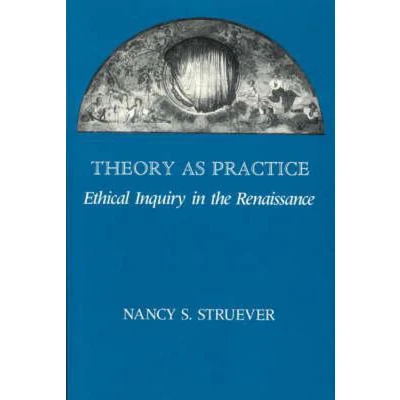
Theory as Practice
Uitgelicht

|
29,64 |
Naar shop
|
| VERGELIJK ALLE AANBIEDERS (1) | ||
 Beschrijving
Bol Partner
There is a tendency in modern scholarship to describe the Renaissance Humanists merely as readers—as interpreters happily absorbed within the bounds of their chosen classical texts. In Theory as Practice, Nancy Struever contests this accepted notion; by focusing on ethical inquiry, she presents the Humanists as engaged in subtle, innovative moral work. Struever argues that the accomplishment of five major Renaissance figures—Petrarch, Nicolaus Cusanus, Lorenzo Valla, Machiavelli, and Montaigne—was to consider theory as practice and thus engage the ethics of inquiry. She notes three stages of investigation, the first represented by Petrarch, who "relocated" ethical inquiry from a theoretical realm to a familiar practice responsive to daily experience. Next, Struever describes how Cusanus and Valla assume Petrarch's relocation, yet confect ethics into discursive disciplines. Finally, while both Machiavelli and Montaigne produced strong revisions of discipline, they considered the problems of addressing the non-inquirer as well. Struever urges modern readers to employ both rhetorical and philosophical analysis to reveal these Humanists' aggressive tactics of presentation as well as their novel disciplinary reorientation. By doing so, she suggests, we discover how Renaissance ethical inquiry illuminates, and is illuminated by, the modern ethical theory of such philosophers as Peirce, Wittgenstein, Bernard Williams, and Quine.


Vergelijk aanbieders (1)

 Beschrijving
(1)
Beschrijving
(1)
There is a tendency in modern scholarship to describe the Renaissance Humanists merely as readers—as interpreters happily absorbed within the bounds of their chosen classical texts. In Theory as Practice, Nancy Struever contests this accepted notion; by focusing on ethical inquiry, she presents the Humanists as engaged in subtle, innovative moral work. Struever argues that the accomplishment of five major Renaissance figures—Petrarch, Nicolaus Cusanus, Lorenzo Valla, Machiavelli, and Montaigne—was to consider theory as practice and thus engage the ethics of inquiry. She notes three stages of investigation, the first represented by Petrarch, who "relocated" ethical inquiry from a theoretical realm to a familiar practice responsive to daily experience. Next, Struever describes how Cusanus and Valla assume Petrarch's relocation, yet confect ethics into discursive disciplines. Finally, while both Machiavelli and Montaigne produced strong revisions of discipline, they considered the problems of addressing the non-inquirer as well. Struever urges modern readers to employ both rhetorical and philosophical analysis to reveal these Humanists' aggressive tactics of presentation as well as their novel disciplinary reorientation. By doing so, she suggests, we discover how Renaissance ethical inquiry illuminates, and is illuminated by, the modern ethical theory of such philosophers as Peirce, Wittgenstein, Bernard Williams, and Quine.
 Productspecificaties
| EAN |
|
|---|---|
| Maat |
|
 Prijshistorie
Prijzen voor het laatst bijgewerkt op:
 Gerelateerde resultaten


