

€ 30,60 Gratis verzending

Uitgelicht
|
|
30,60 |
Naar shop
|

|
30,60 |
Naar shop
|

|
136,00 |
Naar shop
|
| VERGELIJK ALLE AANBIEDERS (3) | ||
 Beschrijving
Vergelijk aanbieders (3)
€ 30,60 Gratis verzending
€ 30,60 Gratis verzending
€ 136,00 Gratis verzending
Winkels met andere maten
Beschrijving
(1)
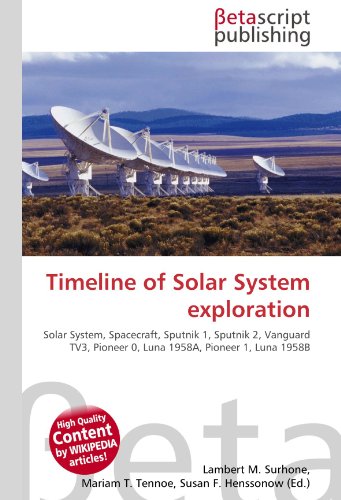
Please note that the content of this book primarily consists of articles available from Wikipedia or other free sources online. The Solar System consists of the Sun and those celestial objects bound to it by gravity, all of which formed from the collapse of a giant molecular cloud approximately 4.6 billion years ago. Of the retinue of objects that orbit the Sun, most of the mass is contained within eight relatively solitary planets whose orbits are almost circular and lie within a nearly-flat disc called the ecliptic plane. The four smaller inner planets, Mercury, Venus, Earth and Mars, also called the terrestrial planets, are primarily composed of rock and metal. The four outer planets, Jupiter, Saturn, Uranus and Neptune, also called the gas giants, are composed largely of hydrogen and helium and are far more massive than the terrestrials.
 Prijshistorie
 * Prijshistorie bevat geen data van Amazon, Amazon Marketplace.
Prijzen voor het laatst bijgewerkt op:
 Gerelateerde resultaten
 Productspecificaties


