
Tractatus Logico Philosophicus
Uitgelicht

|
34,45 |
Naar shop
|

|
34,45 |
Naar shop
|

|
156,00 |
Naar shop
|
| VERGELIJK ALLE AANBIEDERS (3) | ||
 Beschrijving
Bol
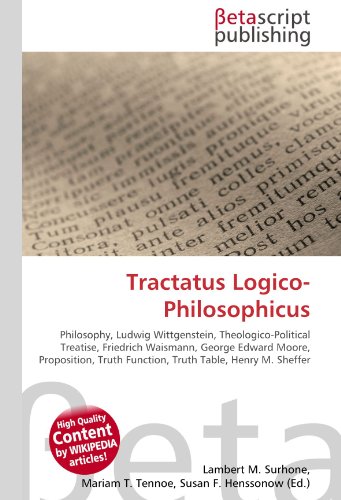
Please note that the content of this book primarily consists of articles available from Wikipedia or other free sources online. Tractatus Logico-Philosophicus is the only book-length philosophical work published by the Austrian philosopher Ludwig Wittgenstein during his lifetime. It is an ambitious project to identify the relationship between language and reality and to define the limits of science.It is recognized as one of the most important philosophical works of the twentieth century. G. E. Moore originally suggested the work's Latin title as homage to Tractatus Theologico-Politicus by Baruch Spinoza. Wittgenstein wrote Tractatus while he was a soldier and prisoner of war during World War I. It was first published in German in 1921 as Logisch-Philosophische Abhandlung. The Tractatus was influential chiefly amongst the logical positivists of the Vienna Circle, such as Rudolf Carnap and Friedrich Waismann. Bertrand Russell's article "The Philosophy of Logical Atomism"is presented as a working out of ideas that he had learnt from Wittgenstein.


 Beschrijving
(1)
Beschrijving
(1)
Please note that the content of this book primarily consists of articles available from Wikipedia or other free sources online. Tractatus Logico-Philosophicus is the only book-length philosophical work published by the Austrian philosopher Ludwig Wittgenstein during his lifetime. It is an ambitious project to identify the relationship between language and reality and to define the limits of science.It is recognized as one of the most important philosophical works of the twentieth century. G. E. Moore originally suggested the work's Latin title as homage to Tractatus Theologico-Politicus by Baruch Spinoza. Wittgenstein wrote Tractatus while he was a soldier and prisoner of war during World War I. It was first published in German in 1921 as Logisch-Philosophische Abhandlung. The Tractatus was influential chiefly amongst the logical positivists of the Vienna Circle, such as Rudolf Carnap and Friedrich Waismann. Bertrand Russell's article "The Philosophy of Logical Atomism"is presented as a working out of ideas that he had learnt from Wittgenstein.
 Productspecificaties
 Prijshistorie
* Prijshistorie bevat geen data van Amazon, Amazon Marketplace.
Prijzen voor het laatst bijgewerkt op:
 Gerelateerde resultaten


