


€ 43,99 Gratis verzending

Uitgelicht
|
|
43,99 |
Naar shop
|

|
46,28 |
Naar shop
|

|
46,28 |
Naar shop
|
| VERGELIJK ALLE AANBIEDERS (3) | ||
 Beschrijving
Vergelijk aanbieders (3)
€ 43,99 Gratis verzending
€ 46,28 Gratis verzending
€ 46,28 Gratis verzending
Winkels met andere maten
Beschrijving
(1)
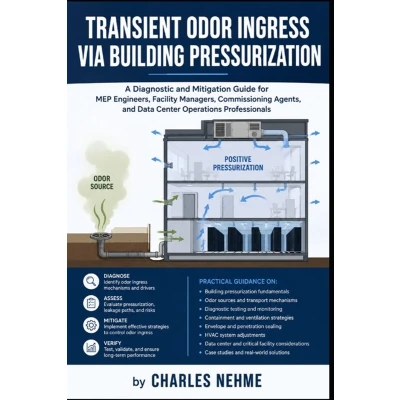
Odor complaints are among the most common yet least systematically investigated indoor environmental quality issues in commercial and mission-critical facilities. Unlike a failed sensor or a tripped breaker, an odor event rarely leaves a physical trace by the time an investigator arrives, and it is frequently intermittent - present during a specific weather condition, a specific fan operating mode, or a specific door-use pattern, and absent at every other time. This transience is precisely what makes odor ingress difficult to diagnose using conventional troubleshooting methods, and it is why so many odor complaints in the field are closed out as "unable to reproduce" without ever identifying a root cause.This guide treats transient odor ingress as what it fundamentally is: an airflow problem governed by building pressurization. An odor cannot enter an occupied space unless air carrying that odor is physically transported across the building envelope or between zones, and that transport is governed by the same differential-pressure physics that govern infiltration, exfiltration, and cross-contamination generally. Once odor ingress is reframed this way, it becomes tractable - the investigator's task shifts from "find the smell" to "find the pressure differential and the pathway it is driving air through," a problem with well-established diagnostic tools.The guide is organized around four sequential questions that mirror how an experienced investigator actually works a case: - What physical forces create the pressure differentials that can move odor-laden air into a space? (Part 1)- Given those forces, where does experience show odor actually gets in, and why? (Part 2)- How does an investigator confirm which pathway and which driver are responsible in a specific building? (Part 3)- Once the pathway and driver are confirmed, what engineering measures reliably close the problem? (Part 4)The content draws on building pressurization theory (ASHRAE Fundamentals, ASHRAE 62.1/62.2), envelope airtightness testing practice, and field-proven diagnostic sequences used in commissioning and forensic investigation of data centers, hospitals, laboratories, and mixed-use commercial buildings. While data center and MEP terminology is used throughout for consistency with this series, the underlying physics and diagnostic method apply equally to any pressurized or semi-pressurized building type.
 Prijshistorie
 * Prijshistorie bevat geen data van Amazon, Amazon Marketplace.
Prijzen voor het laatst bijgewerkt op:
 Gerelateerde resultaten
 Productspecificaties


