


gebruikt € 52,43 Gratis verzending

Uitgelicht
|
|
52,43 |
Naar shop
|

|
115,00 |
Naar shop
|
| VERGELIJK ALLE AANBIEDERS (2) | ||
 Beschrijving
Vergelijk aanbieders (2)
gebruikt € 52,43 Gratis verzending
€ 115,00 Gratis verzending
Winkels met andere maten
Beschrijving
(2)
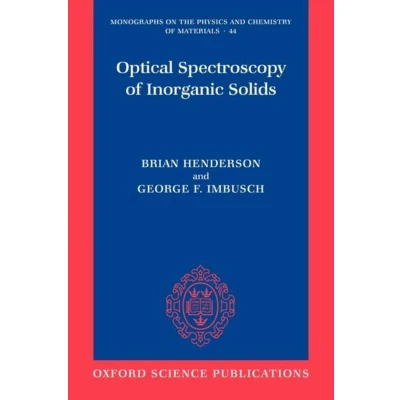
Aims to provide a scientific understanding of the colour and luminescence properties of synthetic and naturally-occurring inorganic materials. This monograph provides the background in many-electron atomic spectroscopy, solid state physics, and the interaction of optically-active centres with electromagnetic radiation. The beautiful colours of many inorganic compounds, including minerals and gemstones, as well as the mysterious cold light of luminescence emitted by these materials, have attracted the inquisitiveness of natural philosophers for centuries. The scientific study of such phenomena - the optical spectroscopy of solids - has paid rich dividends in technological advances such as lasers and other optronic devices. This is a book on the art of optical spectroscopy of solids, establishing a theoretical and experimental framework for the subject, which is well illustrated with relevant spectra and experimental data. Chapters 1 to 5 set down the quantum description of atoms, ions and defects in solids, and the interaction of such centres with electromagnetic radiation. Considerations of symmetry and the effects of lattice vibrations on the spectroscopic properties are treated in detail . The physical bases of prominent experimental techniques are presented in Chapter 6 and their application to colour centres, dopant rare-earth and transition-metal ions are described in Chapters 7 -9. The spectroscopic behaviours of magnetic ions at high concentration are detailed in Chapter 10, followed by a brief review of the operational features of solid state lasers that rely on the foregoing discussion of their optical characteristics. Finally, Chapter 12 describes the application of magneto-optical double resonance techniques to the elucidation of the optical properties of insulating and semi-conducting materials. The authors emphasize that their own interests have guided the selection of topics from the panoply of available choices. They have written the book with senior undergraduates and postgraduates in mind: it is expected also to be useful to seasoned investigators from solid state physics and engineering from inorganic chemistry, and from materials and geological sciences.
Bol PartnerThis book provides a new perspective on how events or conditions in environmental space have influences at other places in that space. In the first half of the book, the authors introduce the general question of propagation of ecological influences through environmental space (terrestrial, aquatic and aerial), then lay out a system for its analysis by organization into four components: initiating events or conditions, vectors conducting influences over space, entities that are transported, and the consequences of these propagation processes. Methods of representing environmental heterogeneity and for modeling transport processes are discussed in the context of such propagations. In the second half of the book, properties of eight general transport vectors and examples of transport models in realistic ecological situations are explained. For each of the vectors, a simulation model is provided on a CD included with the book (users require access to ArcView GIS software).
 Productspecificaties
| EAN |
|
|---|---|
| Maat |
|
 Prijshistorie
 Prijzen voor het laatst bijgewerkt op:
 Gerelateerde resultaten


