
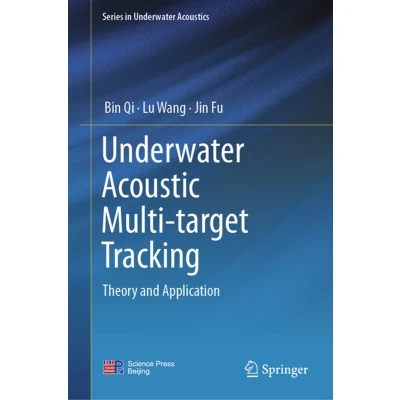
Underwater Acoustic Multi target Tracking: Theory and Application
Uitgelicht

|
139,99 |
Naar shop
|

|
139,99 |
Naar shop
|

|
145,00 |
Naar shop
|
| VERGELIJK ALLE AANBIEDERS (3) | ||
 Beschrijving
Bol
Multi-target tracking, on the other hand, focuses on addressing issues including dividing target batches, obtaining target start and end times, obtaining information about target quantity, as well as filtering out false targets and smoothing trajectories. This book highlights the principles and technology to solve the challenges of multi-target tracking in underwater target detection, with sonar equipment research as the background. While underwater acoustic target detection primarily determines the presence or absence of targets, it fails to provide the information about batches. Multi-target tracking, on the other hand, focuses on addressing issues including dividing target batches, obtaining target start and end times, obtaining information about target quantity, as well as filtering out false targets and smoothing trajectories. For sonar equipment, especially that on unmanned platforms, multi-target tracking is of utmost significance. However, due to a host of uncertainties, multi-target tracking proves extremely challenging in practical sonar applications. These uncertainties include: ① Target motion often comes with random interference, causing sensors to occasionally miss targets; ② The number of targets in the observation area fluctuates randomly; ③ Sensor observations are subject to random noise interference; ④ The quantity of sensor observations varies over time in an unpredictable manner; ⑤ Targets may be too close for sensors to distinguish; and ⑥ Sometimes, even when there are no targets in the observation area, sensors still generate observation data. To tackle these issues, this book systematically elucidates the fundamental principles of multi-target tracking algorithms and introduces a variety of such algorithms. Ultimately, although the book centers on multi-target tracking, the operation of a single sonar or multiple sonar devices aims to solve the problem of locating passive targets. This, in turn, enables the calculation of target position, heading, and speed, as well as the estimation of the target's operational status. The book is a comprehensive and in-depth reference for researchers and engineers engaged in the research and development of sonar equipment as well as graduate students in underwater acoustics.


 Beschrijving
(1)
Beschrijving
(1)
Multi-target tracking, on the other hand, focuses on addressing issues including dividing target batches, obtaining target start and end times, obtaining information about target quantity, as well as filtering out false targets and smoothing trajectories. This book highlights the principles and technology to solve the challenges of multi-target tracking in underwater target detection, with sonar equipment research as the background. While underwater acoustic target detection primarily determines the presence or absence of targets, it fails to provide the information about batches. Multi-target tracking, on the other hand, focuses on addressing issues including dividing target batches, obtaining target start and end times, obtaining information about target quantity, as well as filtering out false targets and smoothing trajectories. For sonar equipment, especially that on unmanned platforms, multi-target tracking is of utmost significance. However, due to a host of uncertainties, multi-target tracking proves extremely challenging in practical sonar applications. These uncertainties include: ① Target motion often comes with random interference, causing sensors to occasionally miss targets; ② The number of targets in the observation area fluctuates randomly; ③ Sensor observations are subject to random noise interference; ④ The quantity of sensor observations varies over time in an unpredictable manner; ⑤ Targets may be too close for sensors to distinguish; and ⑥ Sometimes, even when there are no targets in the observation area, sensors still generate observation data. To tackle these issues, this book systematically elucidates the fundamental principles of multi-target tracking algorithms and introduces a variety of such algorithms. Ultimately, although the book centers on multi-target tracking, the operation of a single sonar or multiple sonar devices aims to solve the problem of locating passive targets. This, in turn, enables the calculation of target position, heading, and speed, as well as the estimation of the target's operational status. The book is a comprehensive and in-depth reference for researchers and engineers engaged in the research and development of sonar equipment as well as graduate students in underwater acoustics.
 Productspecificaties
 Prijshistorie
* Prijshistorie bevat geen data van Amazon, Amazon Marketplace.
Prijzen voor het laatst bijgewerkt op:
 Gerelateerde resultaten


