
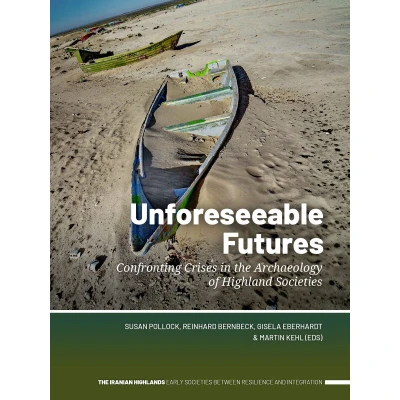
Unforeseeable Futures: Confronting Crises in the Archaeology of Highland Societies
Uitgelicht

|
45,00 |
Naar shop
|

|
45,00 |
Naar shop
|

|
45,00 |
Naar shop
|
| VERGELIJK ALLE AANBIEDERS (3) | ||
 Beschrijving
Bol
How did past societies respond to crisis? This volume investigates archaeological evidence for climate stress, disease, conflict, natural disasters, and social upheaval. It explores the strategies communities developed to adapt, survive, and reshape their worlds in times of uncertainty. Despite their apparent ubiquity today, archaeologists have seldom focused explicitly on crises. The authors in this book take up the challenge of doing so, drawing on archaeological cases from a wide temporal and spatial range. In addition to identifying crises, the contributions search for the factors that underlie them. These range from climate to disease, environmental destruction, sudden natural events such as volcanic eruptions, and intra- or intersocietal conflicts. Factors are often intertwined in complex ways that lead to emergent properties and that can neither be attributable solely to anthropogenic nor to natural causes. Coping with crises include rearrangements of ways of life, such as increasing or decreasing mobility, the use of alternative (‘second-choice’) food sources, recourse to intensified or newly developed rituals, demise of old institutions and/or the building of new ones, and small-scale acts of subversion. This book is the fifth volume of a series published by the German-Iranian research cooperation “The Iranian Highlands: Resiliences and Integration in Premodern Societies”. The goal of the research project is to shine a new light on communities and societies that populated the Iranian highlands and their more or less successful strategies to cope with the many vagaries, the constant changes and risks of their natural and humanly shaped environments.


 Beschrijving
(1)
Beschrijving
(1)
How did past societies respond to crisis? This volume investigates archaeological evidence for climate stress, disease, conflict, natural disasters, and social upheaval. It explores the strategies communities developed to adapt, survive, and reshape their worlds in times of uncertainty. Despite their apparent ubiquity today, archaeologists have seldom focused explicitly on crises. The authors in this book take up the challenge of doing so, drawing on archaeological cases from a wide temporal and spatial range. In addition to identifying crises, the contributions search for the factors that underlie them. These range from climate to disease, environmental destruction, sudden natural events such as volcanic eruptions, and intra- or intersocietal conflicts. Factors are often intertwined in complex ways that lead to emergent properties and that can neither be attributable solely to anthropogenic nor to natural causes. Coping with crises include rearrangements of ways of life, such as increasing or decreasing mobility, the use of alternative (‘second-choice’) food sources, recourse to intensified or newly developed rituals, demise of old institutions and/or the building of new ones, and small-scale acts of subversion. This book is the fifth volume of a series published by the German-Iranian research cooperation “The Iranian Highlands: Resiliences and Integration in Premodern Societies”. The goal of the research project is to shine a new light on communities and societies that populated the Iranian highlands and their more or less successful strategies to cope with the many vagaries, the constant changes and risks of their natural and humanly shaped environments.
 Productspecificaties
 Prijshistorie
* Prijshistorie bevat geen data van Amazon, Amazon Marketplace.
Prijzen voor het laatst bijgewerkt op:
 Gerelateerde resultaten


