








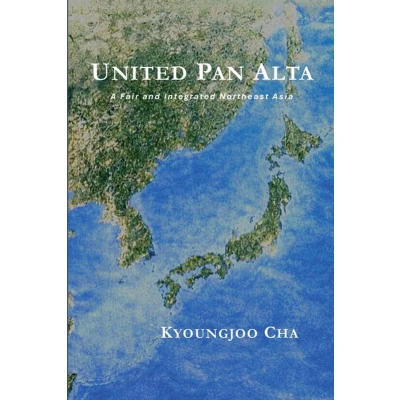
United Pan Alta: A Fair and Integrated Northeast Asia
Uitgelicht

|
21,99 |
Naar shop
|

|
22,80 |
Naar shop
|
| VERGELIJK ALLE AANBIEDERS (2) | ||
 Beschrijving
Bol
Northeast Asia is one of the most consequential regions in the world - and one of the least structurally understood. Home to China, Japan, Korea, Mongolia, and the Russian Far East, it is a land-sea continuum shaped by shared geography, intertwined history, and deep civilizational roots. Yet it remains organized as a collection of competing nation-states, each pursuing dominance rather than balance.United Pan Alta proposes a different architecture.Drawing from history, geography, and long-term civilizational dynamics, this book outlines a structural framework for regional coexistence built on fairness, balance, and phased integration. It introduces the Pan Alta concept - a model of five interconnected nodes spanning the Northeast Asian landmass and its surrounding seas - and traces the geographic, economic, and strategic logic that makes structural alignment not only possible, but necessary.Rather than advocating political unification, United Pan Alta presents a framework for structural alignments - economic, geographic, and strategic - suited to the new millennium. It examines hard alignments, soft alignments, and the digital interface that increasingly shapes regional relationships. It identifies the conditions for a fair start, the risks that could cause failure, and the generational responsibility that makes this work urgent.This is not a manifesto. It is a design.United Pan Alta is essential reading for anyone seeking to understand Northeast Asia not as a theater of rivalry, but as a civilizational space with the structural capacity for lasting peace.


 Beschrijving
(2)
Beschrijving
(2)
Northeast Asia is one of the most consequential regions in the world - and one of the least structurally understood. Home to China, Japan, Korea, Mongolia, and the Russian Far East, it is a land-sea continuum shaped by shared geography, intertwined history, and deep civilizational roots. Yet it remains organized as a collection of competing nation-states, each pursuing dominance rather than balance.United Pan Alta proposes a different architecture.Drawing from history, geography, and long-term civilizational dynamics, this book outlines a structural framework for regional coexistence built on fairness, balance, and phased integration. It introduces the Pan Alta concept - a model of five interconnected nodes spanning the Northeast Asian landmass and its surrounding seas - and traces the geographic, economic, and strategic logic that makes structural alignment not only possible, but necessary.Rather than advocating political unification, United Pan Alta presents a framework for structural alignments - economic, geographic, and strategic - suited to the new millennium. It examines hard alignments, soft alignments, and the digital interface that increasingly shapes regional relationships. It identifies the conditions for a fair start, the risks that could cause failure, and the generational responsibility that makes this work urgent.This is not a manifesto. It is a design.United Pan Alta is essential reading for anyone seeking to understand Northeast Asia not as a theater of rivalry, but as a civilizational space with the structural capacity for lasting peace.
AmazonPagina's: 132, Paperback, Architecture Press LLC
 Productspecificaties
 Prijshistorie
* Prijshistorie bevat geen data van Amazon.
Prijzen voor het laatst bijgewerkt op:
 Gerelateerde resultaten


