


€ 90,99 Gratis verzending

Uitgelicht
|
|
90,99 |
Naar shop
|
| VERGELIJK ALLE AANBIEDERS (1) | ||
 Beschrijving
Vergelijk aanbieders (1)
€ 90,99 Gratis verzending
Winkels met andere maten
Beschrijving
(1)
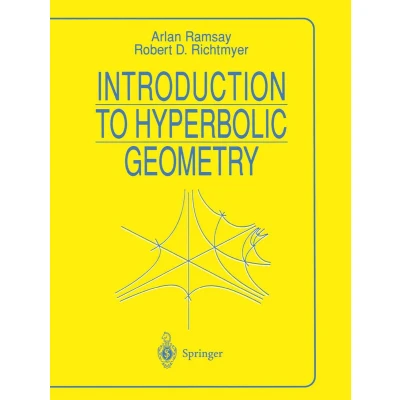
This book is an introduction to hyperbolic and differential geometry that provides material in the early chapters that can serve as a textbook for a standard upper division course on hyperbolic geometry. The book goes well beyond the standard course in later chapters, and there is enough material for an honors course, or for supplementary reading. This text for advanced undergraduates emphasizes the logical connections of the subject. The derivations of formulas from the axioms do not make use of models of the hyperbolic plane until the axioms are shown to be categorical; the differential geometry of surfaces is developed far enough to establish its connections to the hyperbolic plane; and the axioms and proofs use the properties of the real number system to avoid the tedium of a completely synthetic approach. The development includes properties of the isometry group of the hyperbolic plane, tilings, and applications to special relativity. Elementary techniques from complex analysis, matrix theory, and group theory are used, and some mathematical sophistication on the part of students is thus required, but a formal course in these topics is not a prerequisite.
 Productspecificaties
| EAN |
|
|---|---|
| Maat |
|
 Prijshistorie
 Prijzen voor het laatst bijgewerkt op:
 Gerelateerde resultaten


