
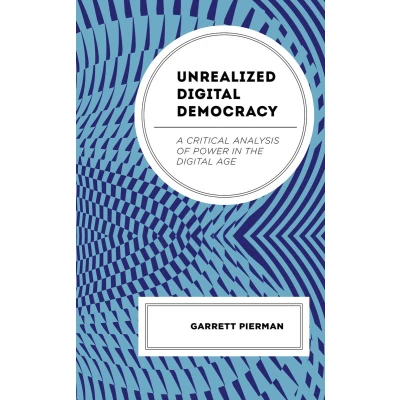
Unrealized Digital Democracy
Uitgelicht

|
74,99 |
Naar shop
|
| VERGELIJK ALLE AANBIEDERS (1) | ||
 Beschrijving
Bol
The author makes the cause for an analysis of digital politics grounded in both materialism and Bruno Latour’s Actor-Network-Theory. Such an analysis identifies asymmetries of digital power in the contemporary internet, explaining some of the more concerning, undemocratic trends of recent years including politically-motivated violence. Garrett Pierman argues that the Internet, as it is structured today, is inhospitable to democracy. What began as a government-funded defense project became, with the commercialization of the Internet in the early 1990s, a network that makes it simultaneously easier for falsehoods to spread and more difficult for people to lose touch with reality. Many millions of Internet users have not encountered the online world as many scholars had hoped, as a place for careful democratic deliberation. The Internet is now a platform in which their fears and anxieties are exploited by corporations that have carved up digital fiefdoms. In these digital fiefdoms, fake news and lies are shared and consumed at speeds that far exceed our ability to sort fact from fiction, leading to instances of political violence once people’s lie-based fears overcome their better judgement. It should be of no surprise that the current Internet enables and encourages political violence: scared and overwhelmed users are the ideal denizens of digital fiefdoms.


Vergelijk aanbieders (1)

 Beschrijving
(1)
Beschrijving
(1)
The author makes the cause for an analysis of digital politics grounded in both materialism and Bruno Latour’s Actor-Network-Theory. Such an analysis identifies asymmetries of digital power in the contemporary internet, explaining some of the more concerning, undemocratic trends of recent years including politically-motivated violence. Garrett Pierman argues that the Internet, as it is structured today, is inhospitable to democracy. What began as a government-funded defense project became, with the commercialization of the Internet in the early 1990s, a network that makes it simultaneously easier for falsehoods to spread and more difficult for people to lose touch with reality. Many millions of Internet users have not encountered the online world as many scholars had hoped, as a place for careful democratic deliberation. The Internet is now a platform in which their fears and anxieties are exploited by corporations that have carved up digital fiefdoms. In these digital fiefdoms, fake news and lies are shared and consumed at speeds that far exceed our ability to sort fact from fiction, leading to instances of political violence once people’s lie-based fears overcome their better judgement. It should be of no surprise that the current Internet enables and encourages political violence: scared and overwhelmed users are the ideal denizens of digital fiefdoms.
 Productspecificaties
| EAN |
|
|---|---|
| Maat |
|
 Prijshistorie
Prijzen voor het laatst bijgewerkt op:
 Gerelateerde resultaten


