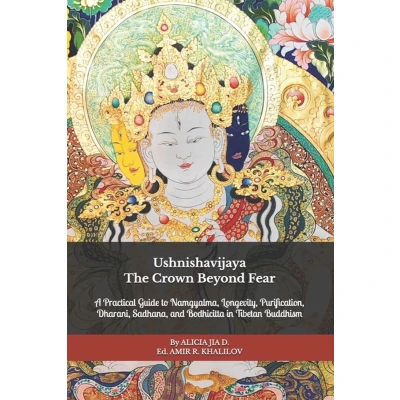


€ 23,10 Gratis verzending

Uitgelicht
|
|
23,10 |
Naar shop
|

|
24,99 |
Naar shop
|
| VERGELIJK ALLE AANBIEDERS (2) | ||
 Beschrijving
Vergelijk aanbieders (2)
€ 23,10 Gratis verzending
€ 24,99 € 2,99 verzendkosten Totaal € 27,98
Winkels met andere maten
Beschrijving
(1)
Ushnishavijaya, known in the Tibetan tradition as Namgyalma, is one of the great long-life deities of Tibetan Buddhism. Her practice is traditionally associated with longevity, the purification of karmic obscurations, protection from unfavorable rebirths, the accumulation of merit and wisdom, and the cultivation of fearlessness in the face of illness, aging, and death.But the meaning of Ushnishavijaya reaches far beyond the simple wish to live longer.This book offers a comprehensive and practice-oriented introduction to Ushnishavijaya for readers who wish to understand both the Buddhist teachings behind the practice and the traditional forms through which it has been transmitted.Beginning with the fundamental questions of life, impermanence, suffering, karma, and dependent origination, the book explains why Buddhist traditions pray for longevity without denying the inevitability of death. It explores the origins and development of Ushnishavijaya through scripture, lineage, ritual, and iconography, and explains the meaning of her white body, three faces, eight arms, mudras, ritual implements, vase of amrita, and enlightened activities.The reader is then guided through the deeper Buddhist meaning of longevity, purification, merit, wisdom, and bodhicitta, showing how these teachings are connected with ethical responsibility and the transformation of body, speech, and mind.The practical sections address offerings, recitation, visualization, refuge, dedication of merit, and the proper relationship between personal practice and lineage transmission. Traditional and concise practice materials are included, together with the heart mantra of Ushnishavijaya, a praise for long life, and a prayer liturgy associated with the Three Long-Life Deities.Throughout the book, careful attention is given to an important distinction: Buddhist ritual is neither superstition nor merely a psychological technique. The traditional religious meaning of dharani, mantra, deity practice, empowerment, oral transmission, and lineage is preserved, while unfamiliar ideas are explained clearly for modern readers.This is therefore more than a mantra book and more than an academic study. It is a bridge between Buddhist doctrine, sacred imagery, devotional practice, and everyday life.For newcomers, it offers a clear map of the Ushnishavijaya tradition. For established practitioners, it provides a structured reference for understanding the meaning behind familiar practices.At its heart lies a simple question: If we are given more time, how should we use it?The answer offered by the practice of Ushnishavijaya is not merely to hold on to life longer, but to use life more wisely: to purify harmful patterns, cultivate compassion and wisdom, fulfill unfinished responsibilities, benefit others, and direct this precious human life toward awakening.
 Prijshistorie
 * Prijshistorie bevat geen data van Amazon.
Prijzen voor het laatst bijgewerkt op:
 Gerelateerde resultaten
 Productspecificaties


