


€ 43,99 Gratis verzending

Gesponsorde links
|
|
43,99 |
Naar shop
|

|
46,18 |
Naar shop
|

|
46,18 |
Naar shop
|
| VERGELIJK ALLE AANBIEDERS (3) | ||
 Beschrijving
Vergelijk aanbieders (3)
Gesponsorde links · Sommige shops betalen ons een vergoeding
€ 43,99 Gratis verzending
€ 46,18 Gratis verzending
€ 46,18 Gratis verzending
Winkels met andere maten
Beschrijving
(1)
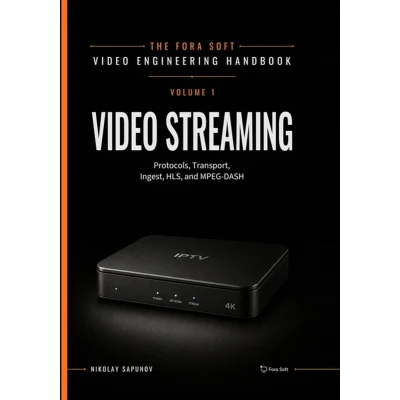
How video actually reaches the viewer - the transport half.An encoder produces a bitstream. Between that bitstream and a picture on a screen sit a network that loses packets, an ingest link that must not drop the show, and a delivery protocol that slices video into files. This volume covers that path end to end, and it is the half almost no one teaches: the protocols are documented in specifications, the practice lives in tribal knowledge, and nothing joins the two.It starts with the shape of the problem - live, VOD and near-live, the glass-to-glass latency budget, what a real network does to a stream. Then the transport foundation: TCP against UDP, congestion control, QUIC and HTTP/3, NAT traversal with STUN, TURN and ICE, and encryption in transit. Then ingest - RTMP and why it survived, SRT and RIST for contribution, WHIP and WebTransport - and a chapter that picks between them on engineering grounds. The largest part is delivery: HLS and Low-Latency HLS, MPEG-DASH, CMAF, the sub-second options, and Media over QUIC, closing with a comparison you can defend in a design review.Every topic reads on its top layer without mathematics and is still accurate; the rigorous layer sits underneath, in boxes you can skip. Each chapter ends with review questions, problems, and a lab you run on FFmpeg, OBS, a browser and a packager.What is inside- The big picture - the delivery problem, codec vs container vs protocol, live and VOD, the latency budget, the pipeline map- The transport foundation - TCP and UDP, congestion control, QUIC and HTTP/3, NAT, STUN, TURN, ICE, media encryption, the last mile- Ingest - RTMP, SRT, RIST, Zixi, WHIP, WebTransport, and how to choose- Delivery - the protocol family, HLS, LL-HLS, MPEG-DASH, CMAF, sub-second delivery, Media over QUIC, and an honest comparisonWho it is forBackend and media engineers building delivery, developers who work next to it, and technical leads who need a protocol choice they can defend. A command line and basic networking are enough - the encoder side is summarised in an appendix, so Book 1 is useful but not required.25 chapters, 7 appendices, 162 figures, a 306-entry bibliography, a 689-entry glossary and index, and 26 labs. Book 2 of 7, Volume 1, in The Fora Soft Video Engineering Handbook; Volume 2 carries the stream from the protocol to the screen and the traffic bill.Nikolay Sapunov is CEO and co-founder of Fora Soft, which has built video, real-time and AI systems since 2005: 250+ delivered projects, a 50-engineer team, systems used by NBC, Coca-Cola and Red Bull. This series is the training the company uses on its own engineers.
 Prijshistorie
* Prijshistorie bevat geen data van Amazon, Amazon Marketplace.
Prijzen voor het laatst bijgewerkt op:
 Gerelateerde resultaten
 Productspecificaties


