
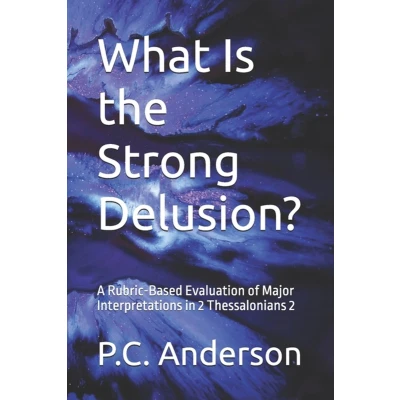
What Is the Strong Delusion?: A Rubric-Based Evaluation of Major Interpretations in 2 Thessalonians
Uitgelicht

|
11,10 |
Naar shop
|

|
11,10 |
Naar shop
|

|
11,50 |
Naar shop
|
| VERGELIJK ALLE AANBIEDERS (3) | ||
 Beschrijving
Bol
What exactly is the "strong delusion" Paul describes in 2 Thessalonians 2:9-12? For centuries, interpreters have wrestled with this sobering passage-where God "sends a strong delusion" so that those who reject the truth "may believe the lie." Is Paul describing judicial hardening, end-times deception, satanic activity under divine sovereignty, covenant judgment, or something more theologically layered?What Is the Strong Delusion? offers the most comprehensive, text-driven evaluation of this question to date. Rather than relying on impressions or inherited assumptions, P. C. Anderson develops a nine-variable rubric drawn directly from the biblical text, its literary structure, Pauline theology, Old Testament judgment motifs, intertextual patterns, and the canonical witness to divine justice and human responsibility.Each major interpretation-Judicial Hardening, Covenant Judgment, Satanic Influence Permitted by God, End-Times Deception, and a Composite Divine-Judicial model-is tested against the same criteria. The result is a transparent, evidence-based comparison that allows readers to see precisely how each view aligns (or struggles to align) with: - Lexical and grammatical details in 2 Thessalonians 2 - Literary structure and narrative placement within Paul's eschatological argument - Historical and theological correspondence with first-century expectations - Pastoral purpose and meaning for the Thessalonian church - Broader biblical theology of judgment, truth, and divine sovereignty - Canonical development across Scripture and early Christian interpretation - Intertextual connections to prophetic delusion, hardening, and covenant motifs - Symbolic and theological coherence within Paul's eschatology - Explanatory economy-which view best accounts for all the data with the fewest assumptionsAnderson's analysis reveals a striking convergence within the biblical canon: the strong delusion is not a peripheral curiosity but a theologically rich, pastorally urgent declaration about divine justice, human refusal of truth, and the ultimate triumph of Christ over deception. The book highlights how Paul weaves together divine initiative, satanic counterfeit power, human culpability, and eschatological hope-without collapsing these elements into simplistic categories.Readers will find this study both sobering and deeply clarifying. It illuminates why the passage has shaped Christian preaching, theology, and pastoral counsel for two millennia, and why its message remains vital today: truth matters eternally, deception is real, judgment is righteous, and God preserves those who love the truth.Whether you approach the topic exegetically, theologically, eschatologically, or pastorally, this book provides a rigorous, structured framework for evaluating the evidence yourself-without revealing the final scoring outcome, so your curiosity drives you deeper into the study.


 Beschrijving
(1)
Beschrijving
(1)
What exactly is the "strong delusion" Paul describes in 2 Thessalonians 2:9-12? For centuries, interpreters have wrestled with this sobering passage-where God "sends a strong delusion" so that those who reject the truth "may believe the lie." Is Paul describing judicial hardening, end-times deception, satanic activity under divine sovereignty, covenant judgment, or something more theologically layered?What Is the Strong Delusion? offers the most comprehensive, text-driven evaluation of this question to date. Rather than relying on impressions or inherited assumptions, P. C. Anderson develops a nine-variable rubric drawn directly from the biblical text, its literary structure, Pauline theology, Old Testament judgment motifs, intertextual patterns, and the canonical witness to divine justice and human responsibility.Each major interpretation-Judicial Hardening, Covenant Judgment, Satanic Influence Permitted by God, End-Times Deception, and a Composite Divine-Judicial model-is tested against the same criteria. The result is a transparent, evidence-based comparison that allows readers to see precisely how each view aligns (or struggles to align) with: - Lexical and grammatical details in 2 Thessalonians 2 - Literary structure and narrative placement within Paul's eschatological argument - Historical and theological correspondence with first-century expectations - Pastoral purpose and meaning for the Thessalonian church - Broader biblical theology of judgment, truth, and divine sovereignty - Canonical development across Scripture and early Christian interpretation - Intertextual connections to prophetic delusion, hardening, and covenant motifs - Symbolic and theological coherence within Paul's eschatology - Explanatory economy-which view best accounts for all the data with the fewest assumptionsAnderson's analysis reveals a striking convergence within the biblical canon: the strong delusion is not a peripheral curiosity but a theologically rich, pastorally urgent declaration about divine justice, human refusal of truth, and the ultimate triumph of Christ over deception. The book highlights how Paul weaves together divine initiative, satanic counterfeit power, human culpability, and eschatological hope-without collapsing these elements into simplistic categories.Readers will find this study both sobering and deeply clarifying. It illuminates why the passage has shaped Christian preaching, theology, and pastoral counsel for two millennia, and why its message remains vital today: truth matters eternally, deception is real, judgment is righteous, and God preserves those who love the truth.Whether you approach the topic exegetically, theologically, eschatologically, or pastorally, this book provides a rigorous, structured framework for evaluating the evidence yourself-without revealing the final scoring outcome, so your curiosity drives you deeper into the study.
 Productspecificaties
 Prijshistorie
* Prijshistorie bevat geen data van Amazon, Amazon Marketplace.
Prijzen voor het laatst bijgewerkt op:
 Gerelateerde resultaten


