


€ 17,43 € 14,66 € 2,99 verzendkosten Totaal € 17,65

Uitgelicht
|
|
17,43
14,66 |
Naar shop
|
| VERGELIJK ALLE AANBIEDERS (1) | ||
 Beschrijving
Vergelijk aanbieders (1)
€ 17,43 € 14,66 € 2,99 verzendkosten Totaal € 17,65
Winkels met andere maten
Beschrijving
(1)
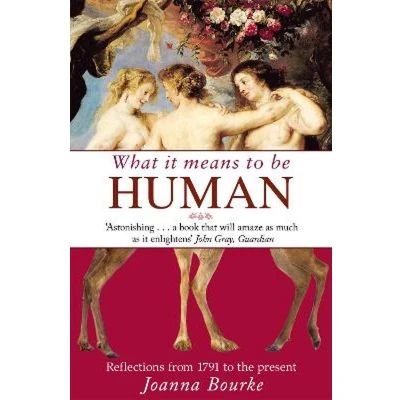
Fiercely intelligent, always provocative, Joanna Bourke turns to the subject of the human animal 'Intellectually energetic and important' Paul Binding, IndependentIn 1872, a woman known only as 'An Ernest Englishwoman' published an open letter entitled 'Are women animals?', in which she protested the fact that the status of women was worse than that of animals: regulations prohibiting cruelty against dogs, horses and cattle were significantly more punitive than laws against cruelty to women. The Ernest Englishwoman's critique could equally have applied to slaves, and if she had been able to look into the future, she might have wondered about chimeras or the ethics of stem cell research.Meticulously researched, wide-ranging and illuminating, What It Means to be Human explores the legacy of two centuries and asks what the future holds for humans and animals.'Provocative [and] exhilarating . . . Bourke's intelligence is sharp, her language lively, and the cultural images striking' Iain Finlayson, The Times'A dauntless exploration . . . With mesmerising dexterity she deconstructs binaries of "human" and "animal" . . . A multitude of fresh ideas and an eye-opening and, at times, shocking intellectual adventure' Joanne Hayden, Sunday Business Post'It is a delight to read such an ambitious book. Bourke deserves congratulations for bravely going where many historians would fear to tread' Sheila Rowbotham, Times Higher Education In 1872, a woman known only as 'An Ernest Englishwoman' published an open letter entitled 'Are women animals?', in which she protested the fact that women were not treated as fully human. In reality, their status was worse than that of animals: regulations prohibiting cruelty against dogs, horses and cattle were significantly more punitive than laws against cruelty to women. What does it mean to be 'human' rather than 'animal'? If the Ernest Englishwoman had turned her gaze to the previous century, her critique could equally have applied to slaves. In her time and beyond, the debate around human status involved questions of language, facial physiology, and vegetarianism. If she had been capable of looking 100 years into the future, she might have wondered about chimeras, created by transplanting animal fluids and organs into human bodies, or the ethics of stem cell research. In this meticulously researched, wide-ranging and illuminating book, Joanna Bourke explores the legacy of more than two centuries, and looks forward to what the future might hold for humans and animals.
 Productspecificaties
| EAN |
|
|---|---|
| Maat |
|
 Prijshistorie
 Prijzen voor het laatst bijgewerkt op:
 Gerelateerde resultaten


