
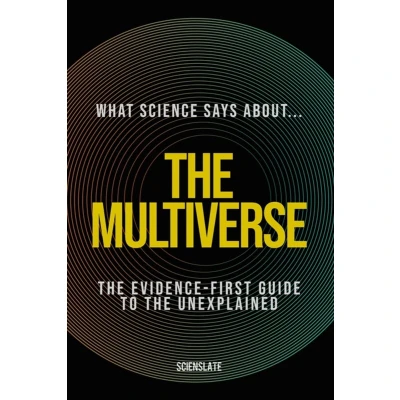
What Science Says About... The Multiverse
Uitgelicht

|
13,00 |
Naar shop
|

|
13,92 |
Naar shop
|

|
13,92 |
Naar shop
|
| VERGELIJK ALLE AANBIEDERS (3) | ||
 Beschrijving
Bol
Is our universe the only one - or one of infinite copies stretching beyond the observable sky?For decades, the multiverse lived at the edge of science fiction. Today, it sits at the center of serious physics. Leading cosmologists and quantum theorists take the idea seriously not because it sounds compelling, but because the mathematics describing our universe keeps pointing toward something beyond it. From inflationary cosmology to the strange implications of quantum mechanics, the multiverse emerges not as fantasy but as a genuine, if controversial, scientific hypothesis.The research reveals a field full of rigorous disagreement. Some physicists argue multiple universes are a near-inevitable consequence of established theory. Others insist the idea is untestable and therefore outside science altogether. This book examines both sides honestly, tracing where the evidence is strong, where it thins into speculation, and why brilliant scientists remain divided.Understanding this debate reshapes how readers think about reality, probability, and their own place in the cosmos - questions with real philosophical weight.Inside, you'll discover: - How inflationary theory naturally predicts multiple universes - What quantum mechanics' many-worlds interpretation actually claims - Why some physicists reject the multiverse as unscientific - The difference between mathematical possibility and testable evidence - How string theory connects to multiverse proposals - What separates genuine cosmological research from popular mythWhat Science Says About... is a series devoted to separating rigorous evidence from popular myth on science's most debated questions. Readers drawn to this volume will find equally clear-eyed explorations throughout the series.Read on to discover what the evidence really shows.


 Beschrijving
(1)
Beschrijving
(1)
Is our universe the only one - or one of infinite copies stretching beyond the observable sky?For decades, the multiverse lived at the edge of science fiction. Today, it sits at the center of serious physics. Leading cosmologists and quantum theorists take the idea seriously not because it sounds compelling, but because the mathematics describing our universe keeps pointing toward something beyond it. From inflationary cosmology to the strange implications of quantum mechanics, the multiverse emerges not as fantasy but as a genuine, if controversial, scientific hypothesis.The research reveals a field full of rigorous disagreement. Some physicists argue multiple universes are a near-inevitable consequence of established theory. Others insist the idea is untestable and therefore outside science altogether. This book examines both sides honestly, tracing where the evidence is strong, where it thins into speculation, and why brilliant scientists remain divided.Understanding this debate reshapes how readers think about reality, probability, and their own place in the cosmos - questions with real philosophical weight.Inside, you'll discover: - How inflationary theory naturally predicts multiple universes - What quantum mechanics' many-worlds interpretation actually claims - Why some physicists reject the multiverse as unscientific - The difference between mathematical possibility and testable evidence - How string theory connects to multiverse proposals - What separates genuine cosmological research from popular mythWhat Science Says About... is a series devoted to separating rigorous evidence from popular myth on science's most debated questions. Readers drawn to this volume will find equally clear-eyed explorations throughout the series.Read on to discover what the evidence really shows.
 Productspecificaties
 Prijshistorie
* Prijshistorie bevat geen data van Amazon, Amazon Marketplace.
Prijzen voor het laatst bijgewerkt op:
 Gerelateerde resultaten


