
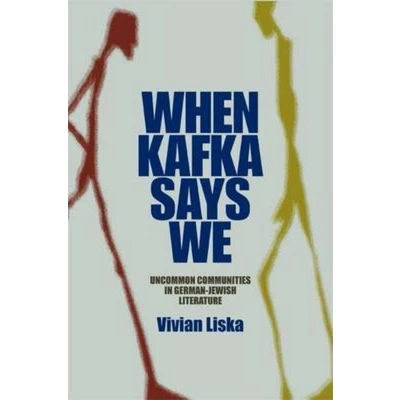
When Kafka Says We: Uncommon Communities in German Jewish Literature
Uitgelicht

|
29,99 |
Naar shop
|

|
32,83 |
Naar shop
|
| VERGELIJK ALLE AANBIEDERS (2) | ||
 Beschrijving
Bol
Taking as its starting point Franz Kafka's complex relationship to Jews and to communities in general, this title explores the ambivalent responses of major German-Jewish writers to self-enclosed social, religious, ethnic, and ideological groups. It presents an analysis that uncovers provocative attitudes and insights on a subject of controversy. Taking as its starting point Franz Kafka's complex relationship to Jews and to communities in general, When Kafka Says We explores the ambivalent responses of major German-Jewish writers to self-enclosed social, religious, ethnic, and ideological groups. Vivian Liska shows that, for Kafka and others, this ambivalence inspired innovative modes of writing which, while unmasking the oppressive cohesion of communal groupings, also configured original and uncommon communities. Interlinked close readings of works by German-Jewish writers such as Kafka, Else Lasker-Schüler, Nelly Sachs, Paul Celan, Ilse Aichinger, and Robert Schindel illuminate the ways in which literature can subvert, extend, or reconfigure established visions of communities. Liska's rich and astute analysis uncovers provocative attitudes and insights on a subject of continuing controversy.


 Beschrijving
(1)
Beschrijving
(1)
Taking as its starting point Franz Kafka's complex relationship to Jews and to communities in general, this title explores the ambivalent responses of major German-Jewish writers to self-enclosed social, religious, ethnic, and ideological groups. It presents an analysis that uncovers provocative attitudes and insights on a subject of controversy. Taking as its starting point Franz Kafka's complex relationship to Jews and to communities in general, When Kafka Says We explores the ambivalent responses of major German-Jewish writers to self-enclosed social, religious, ethnic, and ideological groups. Vivian Liska shows that, for Kafka and others, this ambivalence inspired innovative modes of writing which, while unmasking the oppressive cohesion of communal groupings, also configured original and uncommon communities. Interlinked close readings of works by German-Jewish writers such as Kafka, Else Lasker-Schüler, Nelly Sachs, Paul Celan, Ilse Aichinger, and Robert Schindel illuminate the ways in which literature can subvert, extend, or reconfigure established visions of communities. Liska's rich and astute analysis uncovers provocative attitudes and insights on a subject of continuing controversy.
 Productspecificaties
 Prijshistorie
* Prijshistorie bevat geen data van Amazon.
Prijzen voor het laatst bijgewerkt op:
 Gerelateerde resultaten


