

€ 12,82 Gratis verzending

Gesponsorde links
|
|
12,82 |
Naar shop
|

|
12,82 |
Naar shop
|

|
13,00 |
Naar shop
|
| VERGELIJK ALLE AANBIEDERS (3) | ||
 Beschrijving
Vergelijk aanbieders (3)
Gesponsorde links · Sommige shops betalen ons een vergoeding
€ 12,82 Gratis verzending
€ 12,82 Gratis verzending
€ 13,00 € 2,99 verzendkosten Totaal € 15,99
Winkels met andere maten
Beschrijving
(1)
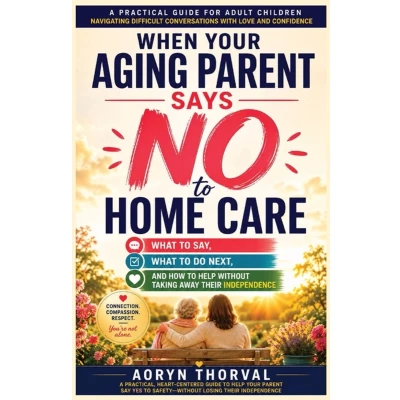
You know something has changed.Maybe your mother is struggling with the house. Maybe your father is having a harder time managing the things he used to handle without thinking. Maybe you have started doing more, worrying more, checking in more, and wondering how long you can keep doing it this way.So you bring up home care.And your parent says: "I'm fine."Or: "I don't need anyone."Or: "I can take care of myself." You try again. They push back. You explain. They get defensive. You leave the conversation frustrated, worried, and wondering what you are supposed to do next. This book starts there.Not with the assumption that your parent is simply being difficult.And not with the assumption that you should override their wishes "for their own good." Instead, it helps you slow the conversation down enough to understand what the no actually means, what belongs to the immediate problem, and what may be connected to a deeper fear about independence, privacy, control, money, or becoming dependent on someone else. You'll learn how to: - Talk about home care without turning the conversation into a battle- Recognize the difference between a genuine no and a no that may be protecting something your parent is afraid of losing- Know what to say when "I'm fine" shuts the conversation down- Avoid the repeated-persuasion cycle that can make your parent more guarded around you- Make a practical suggestion without making your parent feel managed or overruled- Handle a first caregiver who turns out to be the wrong fit without assuming the entire idea has failed- Work through sibling disagreements without putting your parent in the middle- Set realistic limits when love is asking you to do more than you can sustainably give- Know when a conversation about home care needs to become a conversation about safety or professional helpMost importantly, this book gives you a different way to think about the problem. The goal is not to win the argument.The goal is to find a workable next step that takes your parent's independence seriously while also taking your concerns seriously. Because helping an aging parent does not have to mean taking over.And respecting their independence does not have to mean doing nothing. There is a middle ground between those two extremes. If your parent keeps saying no to home care and you are running out of things to say, start here. Learn how to approach the conversation differently, protect the relationship underneath it, and find the next step you can both live with. Your parent may still say no. But you can change what happens next.
 Prijshistorie
* Prijshistorie bevat geen data van Amazon, Amazon Marketplace.
Prijzen voor het laatst bijgewerkt op:
 Gerelateerde resultaten
 Productspecificaties


