
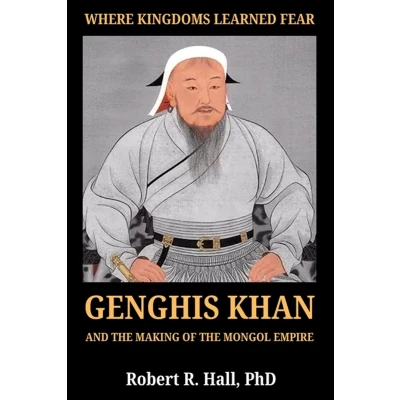
Where Kingdoms Learned Fear: Genghis Khan And The Making Of Mongol Empire
Uitgelicht

|
17,00 |
Naar shop
|

|
21,39 |
Naar shop
|

|
21,39 |
Naar shop
|
| VERGELIJK ALLE AANBIEDERS (3) | ||
 Beschrijving
Bol
A city waits outside its own walls in the spring of 1220, deciding whether resistance or surrender offers the better odds against a conqueror whose reputation has already outrun his army. The man directing the siege was born Temüjin, a boy from a dispossessed Mongol lineage. He spent part of his childhood eating roots and marmots to survive, after his own father's clan abandoned his family to the steppe. By the time he died, he ruled the largest contiguous land empire history has ever recorded. Where Kingdoms Learned Fear traces the full arc of Genghis Khan's life. It follows the betrayals and blood feuds of his adolescence, and the anda bond with Jamukha that curdled into the defining rivalry of his rise. It follows the 1206 kurultai that dismantled a thousand years of steppe tribal loyalty in favor of a single unified nation. And it follows the calculated doctrine of terror that let a numerically limited nomadic army conquer civilizations many times its size. The book follows the empire beyond its founder's death, through Kublai Khan's conquest of Song China, the near-catastrophe of the Mongol invasion of Europe, and the plague-driven collapse that finally fractured the four khanates his sons and grandsons inherited. Drawing on the Secret History of the Mongols and the chronicles of Juvaini and Rashid al-Din, Robert R. Hall traces how a single doctrine of reputation and fear built an empire spanning the length of Eurasia. He also traces why that same doctrine ultimately could not sustain it. Along the way, he shows why the specific mechanics of the terror Genghis Khan mastered still shape how military strategists understand deterrence, credible threat, and the limits of conquest today.


 Beschrijving
(1)
Beschrijving
(1)
A city waits outside its own walls in the spring of 1220, deciding whether resistance or surrender offers the better odds against a conqueror whose reputation has already outrun his army. The man directing the siege was born Temüjin, a boy from a dispossessed Mongol lineage. He spent part of his childhood eating roots and marmots to survive, after his own father's clan abandoned his family to the steppe. By the time he died, he ruled the largest contiguous land empire history has ever recorded. Where Kingdoms Learned Fear traces the full arc of Genghis Khan's life. It follows the betrayals and blood feuds of his adolescence, and the anda bond with Jamukha that curdled into the defining rivalry of his rise. It follows the 1206 kurultai that dismantled a thousand years of steppe tribal loyalty in favor of a single unified nation. And it follows the calculated doctrine of terror that let a numerically limited nomadic army conquer civilizations many times its size. The book follows the empire beyond its founder's death, through Kublai Khan's conquest of Song China, the near-catastrophe of the Mongol invasion of Europe, and the plague-driven collapse that finally fractured the four khanates his sons and grandsons inherited. Drawing on the Secret History of the Mongols and the chronicles of Juvaini and Rashid al-Din, Robert R. Hall traces how a single doctrine of reputation and fear built an empire spanning the length of Eurasia. He also traces why that same doctrine ultimately could not sustain it. Along the way, he shows why the specific mechanics of the terror Genghis Khan mastered still shape how military strategists understand deterrence, credible threat, and the limits of conquest today.
 Productspecificaties
 Prijshistorie
* Prijshistorie bevat geen data van Amazon, Amazon Marketplace.
Prijzen voor het laatst bijgewerkt op:
 Gerelateerde resultaten


