


€ 34,99 Gratis verzending

Gesponsorde links
|
|
34,99 |
Naar shop
|

|
36,92 |
Naar shop
|

|
36,92 |
Naar shop
|
| VERGELIJK ALLE AANBIEDERS (3) | ||
 Beschrijving
Vergelijk aanbieders (3)
Gesponsorde links · Sommige shops betalen ons een vergoeding
€ 34,99 Gratis verzending
€ 36,92 Gratis verzending
€ 36,92 Gratis verzending
Winkels met andere maten
Beschrijving
(1)
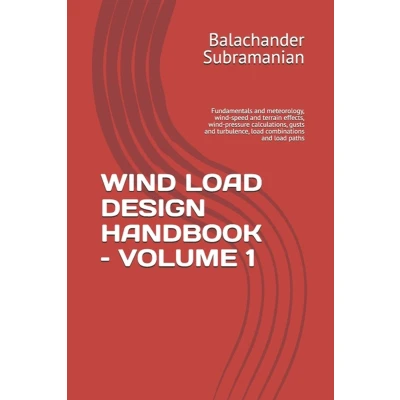
WIND LOAD DESIGN HANDBOOK - VOLUME 1 From Wind Climate and Atmospheric Flow to Structural Wind Loads, Load Paths, Stability, and Performance Wind is one of the most challenging environmental actions encountered in structural engineering. It varies continuously in speed, direction, turbulence, duration, and spatial distribution-and its effects can change dramatically with terrain, height, building geometry, surrounding structures, and structural characteristics. Wind Load Design Handbook - Volume 1 provides a systematic engineering framework for understanding these effects and translating atmospheric wind characteristics into practical structural design actions. >The book explains the complete progression: Wind Climate → Wind Characteristics → Atmospheric Flow → Wind Pressure → Structural Forces → Load Path → Structural Response → Limit-State Verification Particular attention is given to the distinction between global and local wind effects, external and internal pressure, gust and turbulence effects, structural stability, wind-induced drift, vibration, uplift, overturning, torsion, and the performance of components and cladding. The handbook also introduces advanced approaches including: - dynamic wind analysis;- wind tunnel testing;- computational fluid dynamics;- performance-based wind engineering;- reliability and probabilistic methods;- structural monitoring;- digital wind workflows;- artificial intelligence applications; and- aerodynamic optimization. The book emphasizes that a safe wind-resistant structure requires more than an adequate primary frame. Wind forces must travel through a continuous load path from the building envelope through secondary members, connections, diaphragms, collectors, lateral systems, foundations, and ultimately into the ground. Designed for structural engineers, civil engineers, wind engineers, architects, façade specialists, bridge and tower engineers, consultants, contractors, researchers, and engineering students, this volume combines fundamental theory with practical engineering principles, illustrative examples, design workflows, checklists, and quality-control guidance. >Understand the wind. Understand the structure. Design the complete system. The book strongly supports positioning this volume as a foundational professional reference rather than merely a wind-load calculation book: its stated scope progresses from meteorology and atmospheric flow through pressure calculations, structural response, specialized structures, computational methods, and advanced/digital workflows.
 Prijshistorie
* Prijshistorie bevat geen data van Amazon, Amazon Marketplace.
Prijzen voor het laatst bijgewerkt op:
 Gerelateerde resultaten
 Productspecificaties


