


€ 11,00 € 2,99 verzendkosten Totaal € 13,99

Uitgelicht
|
|
11,00 |
Naar shop
|

|
11,79 |
Naar shop
|

|
11,79 |
Naar shop
|
| VERGELIJK ALLE AANBIEDERS (3) | ||
 Beschrijving
Vergelijk aanbieders (3)
€ 11,00 € 2,99 verzendkosten Totaal € 13,99
€ 11,79 Gratis verzending
€ 11,79 Gratis verzending
Winkels met andere maten
Beschrijving
(1)
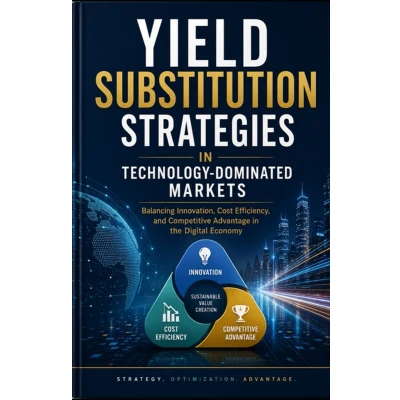
This book explored how yield substitution strategies have become central to success in technology-dominated markets. Yield substitution refers to replacing inefficient systems, processes, resources, or business models with more productive and scalable alternatives capable of generating greater operational efficiency, profitability, innovation, and competitive advantage. Across industries, organizations increasingly substitute manual operations with automation, traditional infrastructure with cloud computing, labor-intensive workflows with artificial intelligence, and linear business models with interconnected digital ecosystems. The book demonstrated how technological transformation continuously reshapes industries, consumer expectations, supply chains, financial systems, and global competition.The chapters examined the major forces driving this transformation, including artificial intelligence, automation, cloud infrastructure, digital platforms, predictive analytics, smart supply chains, sustainable technologies, and ecosystem-based competition. The book also explored the economic foundations of substitution strategies, explaining how businesses optimize productivity through scalability, network effects, data-driven decision-making, and operational flexibility. It analyzed the financial implications of digital transformation, the growing influence of government regulation, the role of consumer behavior in technology adoption, and the increasing importance of sustainability, cybersecurity, and organizational adaptability. Throughout the discussion, real-world examples illustrated how companies use technological substitution to strengthen market positioning and reshape entire industries.Ultimately, the book argued that sustainable competitive advantage in the modern economy depends on continuous adaptation rather than static dominance. Organizations that successfully integrate innovation, ethical governance, operational resilience, and long-term strategic thinking are more likely to thrive in rapidly evolving digital markets. As artificial intelligence, quantum computing, autonomous systems, biotechnology, and immersive digital ecosystems continue advancing, yield substitution strategies will become even more influential in determining economic leadership and global competitiveness. The future belongs to organizations capable of balancing technological acceleration with human value creation, sustainability, resilience, and strategic agility in an increasingly interconnected world.
 Prijshistorie
 * Prijshistorie bevat geen data van Amazon, Amazon Marketplace.
Prijzen voor het laatst bijgewerkt op:
 Gerelateerde resultaten
 Productspecificaties


