


€ 43,99 Gratis verzending

Gesponsorde links
|
|
43,99 |
Naar shop
|

|
46,18 |
Naar shop
|

|
46,18 |
Naar shop
|
| VERGELIJK ALLE AANBIEDERS (3) | ||
 Beschrijving
Vergelijk aanbieders (3)
Gesponsorde links · Sommige shops betalen ons een vergoeding
€ 43,99 Gratis verzending
€ 46,18 Gratis verzending
€ 46,18 Gratis verzending
Winkels met andere maten
Beschrijving
(1)
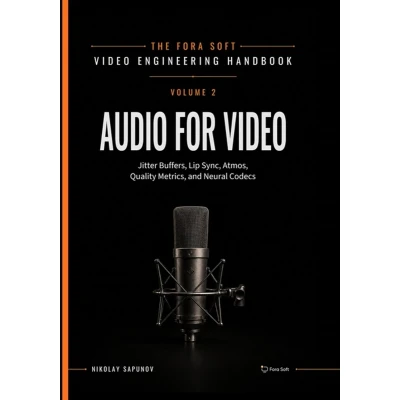
The network's side of sound: loss, drift, lip sync, space, and what comes after.Every senior engineer believes they understand lip sync; almost none can draw the diagram. Volume 1 got the voice cleaned up and ready to send. This volume covers what happens to it afterwards - across a lossy network, through three clock domains, into a spatial scene, and under measurement - and it is the part of audio engineering that costs the most production incidents.It opens with the receiver: the jitter buffer and NetEq, packet loss concealment with FEC and RED, bitrate and topology decisions, recording and transcription at scale, and a troubleshooting chapter organised by symptom. Then synchronization, treated properly for once: the tolerance windows, PTS, DTS and PCR, RTP timestamps and RTCP sender reports, clock domains and drift, how sync actually works in WebRTC against HLS and DASH, and how to test it. Then spatial audio - the multichannel history, the channel/object/scene model, Dolby Atmos, MPEG-H 3D Audio, ambisonics, HRTF and binaural, and spatial sound in VR, AR and conferencing. It closes on quality and the future: objective metrics including POLQA and ViSQOL, subjective testing, AI in the audio chain, and neural codecs.Every topic reads on its top layer without mathematics and is still accurate; the rigorous layer sits underneath, in boxes you can skip. Each chapter ends with review questions, problems, and a lab you run on FFmpeg, WebRTC tooling and a measurement harness.What is inside- Real time, the network's side - jitter buffer and NetEq, PLC, FEC and RED, bitrate and topologies, recording and transcription at scale, troubleshooting by symptom- Synchronization - lip-sync tolerance, PTS/DTS/PCR, RTP timestamps and RTCP, clock domains and drift, sync in WebRTC, HLS and DASH, and how to test it- Spatial audio - multichannel history, channel/object/scene, Dolby Atmos, MPEG-H 3D Audio, ambisonics, HRTF and binaural, VR, AR and conferencing- Quality, AI and the future - objective metrics, subjective testing, AI in the audio chain, neural codecsWho it is forWebRTC and conferencing engineers, media engineers who own sync, and technical leads deciding on spatial audio and quality measurement. A short bridge chapter recaps Volume 1, so this volume can be read on its own.22 chapters, 7 appendices, 141 figures, a 333-entry bibliography, an 859-entry glossary and index, and 22 labs. Book 5 of 7, Volume 2, in The Fora Soft Video Engineering Handbook.Nikolay Sapunov is CEO and co-founder of Fora Soft, which has built video, real-time and AI systems since 2005: 250+ delivered projects, a 50-engineer team, systems used by NBC, Coca-Cola and Red Bull. This series is the training the company uses on its own engineers.
 Prijshistorie
* Prijshistorie bevat geen data van Amazon, Amazon Marketplace.
Prijzen voor het laatst bijgewerkt op:
 Gerelateerde resultaten
 Productspecificaties


